
Running a business in London means operating under constant commercial pressure, and IT infrastructure sits at the centre of almost every operational decision. When the question arises of whether to build an internal IT team or engage a managed IT services provider, many SME owners assume the answer hinges purely on headcount. The reality is more precise: the comparison involves total employment cost, security risk exposure, regulatory obligation, and the depth of technical capability a business can actually access at each price point. This article examines each dimension in concrete terms, drawing on verified cost data and the compliance obligations that apply specifically to London-based businesses.
Table of Contents
- Quick Takeaways
- The True Cost of In-House IT Support
- What Managed IT Services Actually Deliver
- Security and Cyber Risk: Why SMEs Are Disproportionately Exposed
- Compliance Obligations for London SMEs
- Comparing IT Support Models: A Side-by-Side View
- Scalability and Strategic Value
- Frequently Asked Questions
- References
Quick Takeaways
| Key Insight | Explanation |
|---|---|
| In-house IT carries a high hidden cost burden | A single fully loaded IT engineer in London costs £50,000 to £70,000 per year once salary, employer National Insurance, pension, training, and tools are included. A small three-person team can exceed £210,000 annually before recruitment and management overhead. |
| Managed IT support typically costs £50 to £100 per user per month | A 30-person London SME can expect to pay roughly £1,500 to £3,000 per month for a comprehensive managed service, covering helpdesk, monitoring, security, and cloud management under a single predictable fee. |
| Half of UK businesses experienced a cyberattack in 2024 | According to the UK Government’s Cyber Security Breaches Survey 2024, 50% of UK businesses reported a cyber security breach or attack in that year, with medium-sized businesses reaching 70%. SMEs with no dedicated security function are disproportionately at risk. |
| Compliance is no longer optional for SMEs | UK GDPR, Cyber Essentials, and sector-specific frameworks now apply to businesses of all sizes. Failing to meet them exposes SMEs to regulatory penalties and the risk of losing contracts with larger clients who require supply-chain assurance. |
| Managed IT provides access to specialist depth an SME cannot hire internally | A managed service provider brings network engineers, cloud architects, and security specialists to bear at a fraction of the cost of hiring each role separately. Access to this breadth of expertise is practically unavailable to most SMEs through direct employment. |
| Proactive monitoring reduces downtime before problems become visible | Reactive IT support resolves problems after they occur. Proactive managed IT monitors infrastructure continuously, identifying and remediating issues before they affect users or business operations. |
| The UK managed services market is growing rapidly | The UK managed services sector was valued at approximately £15.35 billion in 2023 and is projected to reach £28.29 billion by 2032, reflecting a sustained shift in how businesses choose to resource their IT functions. |
The True Cost of In-House IT Support
The salary line in a job advertisement is the starting point, not the total cost of an in-house IT hire. In London, an IT support technician commands a higher salary than the national average, typically around £29,400 at median level, reflecting the city’s elevated cost of employment. But that figure understates actual expenditure considerably.
Once employer National Insurance contributions, pension obligations, paid leave, training and certification costs, hardware, and software tooling are added, a single in-house IT engineer costs a London SME between £50,000 and £70,000 per year in total. A minimal team of three, which is the smallest configuration capable of providing meaningful cover across different disciplines, can easily exceed £210,000 annually before recruitment fees, management time, or the cost of covering absences.
The Recruitment and Continuity Risk
In-house IT also introduces a structural vulnerability that is easy to overlook during periods of stability. When a sole IT employee resigns, is unwell, or takes leave, the business is left exposed. Recruitment in the London IT market is competitive and typically takes several months. In the interim, either operations suffer or expensive interim contractors fill the gap at rates well above the permanent salary equivalent.
There is also a knowledge concentration problem. A single in-house hire, no matter how capable, carries expertise across a finite range of disciplines. Networking, cloud administration, cybersecurity, and compliance monitoring are each specialist areas. Expecting one person to perform competently across all of them is unrealistic, and the skills gap this creates tends to remain invisible until something fails.
Pro tip: Before comparing monthly costs between in-house and managed IT, calculate the fully loaded annual cost of your current or proposed in-house team. Include employer NI, pension, training budget, tooling licences, and an estimate of management overhead. The resulting figure is almost always higher than decision-makers initially expect.

What Managed IT Services Actually Deliver
Managed IT support is a structured service model in which an external provider takes ongoing responsibility for a business’s IT infrastructure, systems, and user support. The scope varies by contract, but a well-designed managed service for a London SME will typically cover rapid-response helpdesk support, continuous proactive monitoring, patching and maintenance, cloud platform management, security tooling, and access to senior technical expertise for strategic decisions.
For businesses running Microsoft 365 environments, this means day-to-day administration of Exchange, SharePoint, Teams, and OneDrive is handled by the provider, along with licensing, policy management, and compliance controls through tools such as Entra ID and Intune. For organisations using Azure, AWS, or Google Cloud Platform, managed IT extends to infrastructure monitoring, cost optimisation, and security configuration, functions that require specialist knowledge most SMEs cannot maintain internally.
Predictable Pricing Against Variable In-House Cost
One of the clearest commercial advantages of managed IT is cost predictability. Managed services are typically priced on a per-user per-month basis, with fees for London SMEs generally falling between £50 and £100 per user per month depending on the scope of service. A 30-person business can therefore budget accurately for IT support without absorbing the variable costs associated with emergency contractor engagements or urgent hardware replacements handled reactively.
This model also aligns expenditure with headcount. As the business grows, IT costs scale proportionally rather than requiring the step-change investment of an additional internal hire at a full employment cost.
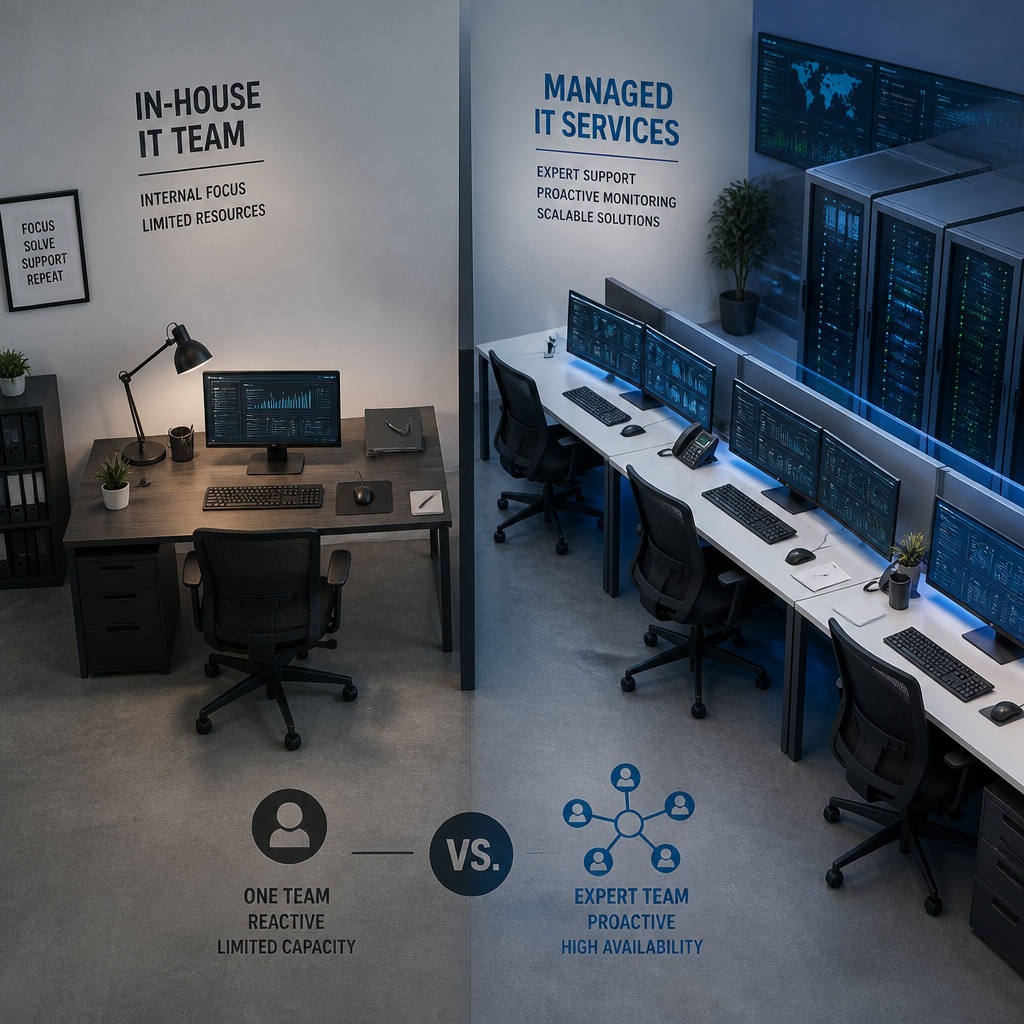
The difference between reactive IT support and proactive managed IT is not just operational. It is the difference between a business that absorbs IT failures and one that prevents them. Downtime has a direct revenue and reputational cost that rarely appears in a cost-comparison spreadsheet until after the event.
Quarterly Technology Reviews as a Strategic Input
Providers offering structured managed IT services in London at a senior level will supplement operational support with periodic strategic reviews. These sessions assess how the business’s technology estate is aligned with its commercial direction, identify technical debt, and surface opportunities to improve efficiency or reduce cost. This is the kind of input that a sole IT employee rarely has the time or seniority to deliver consistently.
Security and Cyber Risk: Why SMEs Are Disproportionately Exposed
The UK Government’s Cyber Security Breaches Survey 2024 found that 50% of UK businesses experienced a cyber security breach or attack in the preceding twelve months. The figure rises to 70% for medium-sized businesses. For SMEs without a dedicated security function, the risk profile is particularly acute: they represent attractive targets because their defences are often thinner, while the commercial consequences of a breach are proportionally more severe than for larger organisations with deeper reserves.
Cybersecurity is a discipline that evolves continuously. Threat actors change their methods, new vulnerabilities are disclosed regularly, and the attack surfaces that businesses present, including email, endpoint devices, cloud infrastructure, and identity systems, each require specialist attention. Keeping pace with this environment requires dedicated resource. A generalist in-house IT employee cannot realistically maintain current expertise across all of these areas alongside their day-to-day support responsibilities.
What Proactive Monitoring Addresses That Reactive Support Cannot
A managed IT provider operating with proactive monitoring tools continuously watches infrastructure for anomalous behaviour, failed authentication attempts, unpatched systems, and configuration drift. Issues are identified and addressed before they escalate into incidents. Reactive support, whether in-house or ad hoc, addresses problems only after they have already affected operations.
In practice, the cost difference between proactive and reactive security management is most visible in the aftermath of an incident. Breach response, data recovery, regulatory notification, and reputational management each carry significant cost. The financial and operational impact of a single security incident almost always exceeds the annual cost of the managed IT arrangement that would have prevented it.
Pro tip: When evaluating a managed IT provider’s security capability, ask specifically how they handle patch management cadence, what their escalation procedure is for a suspected active breach, and whether their monitoring is staffed outside business hours. The answers will quickly differentiate providers with genuine operational maturity from those offering monitoring in name only.

Compliance Obligations for London SMEs
UK GDPR requires all businesses handling personal data to implement appropriate technical and organisational measures to protect it. This is not a recommendation but a legal obligation, and it applies regardless of company size. For SMEs, meeting this requirement involves secure configuration of systems, access controls, data retention policies, and the ability to demonstrate compliance to a regulator or to clients conducting due diligence.
Beyond UK GDPR, the Cyber Essentials scheme, administered by the National Cyber Security Centre, is increasingly a contractual requirement for businesses supplying government bodies or larger private sector organisations. Cyber Essentials Plus and ISO 27001 represent progressively deeper levels of assurance that clients in regulated industries or public procurement regularly mandate. SMEs that cannot demonstrate compliance risk losing contracts they might otherwise win.
How Managed IT Support Addresses Compliance Continuously
Achieving compliance is one challenge. Maintaining it is another. Systems change, staff join and leave, configurations drift, and new regulatory guidance is issued. A managed IT provider with a compliance focus maintains the technical controls that underpin certifications on an ongoing basis, rather than treating compliance as a one-time project.
For a London SME without internal IT expertise, the practical work of maintaining access controls, monitoring for policy violations, managing device compliance through tools like Microsoft Intune, and preparing for external audits requires consistent specialist attention. Outsourcing this function to a managed security and compliance service ensures that the work is done by people for whom it is a primary responsibility, not an afterthought.
Comparing IT Support Models: A Side-by-Side View
The three principal models available to a London SME are a dedicated in-house IT team, ad hoc reactive support from freelance contractors, and a structured managed IT service. Each carries different cost profiles, risk characteristics, and capability limits.
| Dimension | In-House IT Team | Ad Hoc / Break-Fix Support | Managed IT Services (MSP) |
|---|---|---|---|
| Annual cost (30-person SME) | £150,000+ for a 3-person team, fully loaded | Unpredictable. Hourly rates typically £60 to £75, with no cap on incidents | Approximately £18,000 to £36,000 per year at £50 to £100 per user per month |
| Cost predictability | Moderate. Base costs are fixed but incidents, training, and tooling vary | Low. Costs fluctuate with incident frequency and severity | High. Monthly fee is fixed regardless of incident volume |
| Depth of expertise | Limited to the skills of the individuals employed | Limited to the skills of the contractor engaged at the time | Broad. Access to specialists across networking, cloud, security, and compliance |
| Security monitoring | Dependent on internal resource and tooling investment | Not included as standard. Reactive only | Continuous proactive monitoring included in scope |
| Compliance support | Possible if the right skills are hired, but rarely a primary focus | Not included | Included, covering UK GDPR technical controls, Cyber Essentials, and audit preparation |
| Scalability | Requires additional hiring at full employment cost | Scales reactively but unpredictably | Scales cleanly with headcount at a proportional monthly cost |
| Business continuity cover | Dependent on team size. A solo hire creates a single point of failure | No guaranteed response time or cover commitment | Defined SLAs with guaranteed response times and escalation paths |
Scalability and Strategic Value
For a London SME at an early stage of growth, the decision between in-house and managed IT often comes down to which model can flex with the business most efficiently. In-house hiring is a step-change: costs increase in large increments each time a new employee is brought on, and the capacity to absorb those increments depends heavily on the business’s growth trajectory at the time the decision is made.
Managed IT services scale continuously. Additional users are added to the service contract at the existing per-user rate. When the business adds a new office, migrates to a new cloud platform, or takes on a client with specific security requirements, the managed service provider adjusts its scope rather than the business recruiting an additional specialist it may not need permanently.
From Cost Centre to Business Capability
The most significant shift in thinking for businesses that move from reactive IT to a structured managed IT services model is the change in how IT is experienced operationally. Rather than being a source of recurring problems and unplanned expenditure, IT becomes a stable and documented business function with defined SLAs, transparent reporting, and a technology roadmap aligned to commercial objectives.
This is the context in which quarterly technology reviews add genuine value. When a managed service provider conducts a structured review of a business’s IT environment, the output is not simply a list of maintenance tasks. It is an informed view of where the current technology estate supports or constrains the business’s plans, and what investments or changes would close that gap. For SME leaders who are not themselves technically expert, this input is a resource they cannot easily replicate through any other means at comparable cost.
Businesses that have previously managed IT through a combination of ad hoc contractors and internal informal arrangements frequently find that the transition to a managed service reveals significant technical debt: outdated systems, misconfigured cloud environments, unlicensed software, and security gaps that had accumulated without visibility. Identifying and resolving this debt early reduces both the risk of a significant incident and the cost of future IT management.
For London SMEs specifically, the density of the business environment and the expectations of enterprise clients around security and compliance make a well-managed IT function not just operationally sensible but commercially necessary. A robust security posture supported by a capable managed IT partner is increasingly a prerequisite for winning and retaining business, not merely a cost to be minimised.
Frequently Asked Questions
What is the typical cost of managed IT services for a London SME?
Managed IT services for a London SME are typically priced on a per-user per-month basis, with fees generally falling between £50 and £100 per user depending on the scope of services included. A 30-person business should expect to budget approximately £1,500 to £3,000 per month for a comprehensive service covering helpdesk, proactive monitoring, security, and cloud management. This compares favourably to the fully loaded cost of maintaining an equivalent in-house team.
What does managed IT support include that in-house IT typically does not?
A managed IT support service typically includes continuous proactive infrastructure monitoring, access to specialists across multiple disciplines including security and cloud architecture, defined SLAs with guaranteed response times, compliance support for UK GDPR and certifications such as Cyber Essentials, and structured quarterly technology reviews. These are functions that most SMEs cannot practically deliver through a small in-house team, whose capacity is generally consumed by day-to-day helpdesk activity.
Is managed IT services London relevant for businesses with fewer than 20 employees?
Managed IT services are well suited to businesses of fewer than 20 employees. At this scale, the cost of even a single in-house IT hire, typically £50,000 to £70,000 fully loaded, is disproportionate to the workload. A managed service provides access to a full team of specialists at a monthly cost scaled to the business’s actual size. The compliance and security requirements that apply to small businesses, including UK GDPR obligations, do not diminish with headcount, making external expertise particularly valuable at this stage.
How does a managed service provider help with cybersecurity specifically?
A managed service provider with a security focus will implement and maintain technical controls across the primary attack surfaces: email security, endpoint protection, identity management, cloud configuration, and network monitoring. Proactive monitoring tools detect anomalous behaviour and potential threats in real time, and incidents are escalated and managed according to a defined procedure. For SMEs, this represents a level of security maturity that is practically unattainable through internal resources alone, and it directly supports compliance with UK GDPR and Cyber Essentials requirements.
What should a London SME look for when choosing a managed IT services provider?
The key criteria are depth of technical capability across cloud platforms (particularly Microsoft 365 and Azure), clearly defined SLAs with measurable response time commitments, transparent pricing without variable charges for routine activity, a demonstrable approach to security and compliance, and the seniority of engineers assigned to client accounts. Providers who assign senior-level engineers rather than first-line technicians to client work deliver materially different outcomes. It is also worth confirming that the provider offers structured strategic reviews rather than purely operational support, ensuring that IT investment remains aligned with business direction over time.
Can a London SME transition from in-house IT to a managed service provider without disruption?
Yes, and the transition is typically structured in phases to ensure continuity. A managed service provider will begin with a discovery and documentation phase, assessing the current IT environment, identifying gaps, and establishing baselines. Service delivery begins formally once this foundation is in place. For businesses moving away from an in-house arrangement, the managed provider can work alongside existing staff during a transition period, or take full responsibility from an agreed date, depending on the preferred approach. The initial discovery phase frequently surfaces technical debt or security gaps that had not previously been visible, which is one of the early practical benefits of the engagement.
We would welcome your perspective on this topic: if your business has made the transition between IT support models, we are interested to hear what factors proved most significant in practice.
We would love your feedback and any insights you would share with others. What perspective would you add?
References
- In-house IT vs managed IT support: a comparison for growing UK companies, covering cybersecurity risk and the Cyber Security Breaches Survey 2024
- Managed IT support vs in-house IT: what is best for UK SMEs, including UK managed services market growth data
- Full cost comparison of in-house IT versus outsourced IT for UK businesses, including fully loaded salary figures
- IT support costs for SMEs: a detailed breakdown of in-house team costs versus managed service pricing in the UK