
Hiring a full in-house IT team sounds like a straightforward decision until the true cost lands on the balance sheet. For the majority of London SMEs, a single mid-level IT engineer commands a salary well above the London average, and that figure represents only the starting point before employer National Insurance, pension contributions, recruitment fees, training budgets, and software tooling are accounted for. Outsourced IT support resolves that cost problem directly, but cost alone does not explain why so many London business owners are moving to a fully managed, virtual IT department model. This guide examines the structural reasons that model outperforms an in-house team, what it actually delivers in practice, and how to evaluate the decision with precision.
Table of Contents
- Quick Takeaways
- The Real Cost of In-House IT for London SMEs
- What a Virtual IT Department Actually Delivers
- Outsourced IT Services and Cyber Security
- Cloud Management and Compliance
- In-House vs. Outsourced vs. Hybrid: A Direct Comparison
- Choosing an Outsourced IT Support Provider in London
- Frequently Asked Questions
- References
Quick Takeaways
| Key Insight | Explanation |
|---|---|
| True in-house IT costs exceed salary by 40 to 60 percent | Employer on-costs, recruitment fees, training, and tooling inflate the headline salary figure significantly for every hire. |
| A 50-person London SME can spend £78,000 to £121,000 per year on a single in-house IT function | Managed IT services typically deliver the same coverage for a predictable per-user monthly fee, often materially lower. |
| One generalist cannot cover all disciplines | A single in-house hire cannot simultaneously provide senior network engineering, cloud architecture, cyber security, and strategic IT management at the required depth. |
| 43 percent of UK SMEs reported a cyberattack in the prior year | Outsourced IT support providers with dedicated security practices offer 24-hour monitoring that a small internal team cannot sustain. |
| Scalability is immediate with an outsourced IT department | Headcount growth, new office locations, or cloud migrations are absorbed within an existing contract rather than requiring new recruitment cycles. |
| SLA-backed response times are measurable and contractual | Unlike internal arrangements where priority is informally negotiated, a managed provider commits to specific resolution windows in writing. |
| Strategic IT direction requires senior-level input, not just reactive support | A virtual IT department model includes quarterly technology reviews and access to senior engineers, replacing the need for a costly internal IT Director. |
The Real Cost of In-House IT for London SMEs
Most cost comparisons between outsourced and in-house IT fail because they measure only salary. The salary advertised on a job board is the floor, not the ceiling, of what an in-house IT hire costs a London business.
For a typical UK SME with 50 employees, maintaining an in-house IT function costs an estimated £78,000 to £121,000 per year when all employment costs, tooling, training, and recruitment are included. At 75 users requiring a three-person team, one published analysis placed the annual cost at roughly £180,000, compared with approximately £85,500 for equivalent managed IT coverage. That difference of nearly £95,000 per year represents capital that most SMEs would deploy more productively elsewhere.
The hidden items that routinely blindside business owners include agency recruitment fees of 15 to 20 percent of first-year salary each time a hire is made, mandatory pension contributions, employer National Insurance, software licences that each engineer needs to do the job, ongoing CPD and vendor certification costs, and the productivity gap that opens every time a team member is unwell or resigns. None of these appear on the original staffing budget.
Pro tip: Before approving an in-house IT headcount, calculate the fully loaded annual cost: base salary plus employer NI (currently 13.8 percent on earnings above the secondary threshold), pension auto-enrolment contribution, recruitment agency fee, hardware, and an allowance for one replacement hire in three years. The resulting figure is almost always materially higher than the initial estimate.

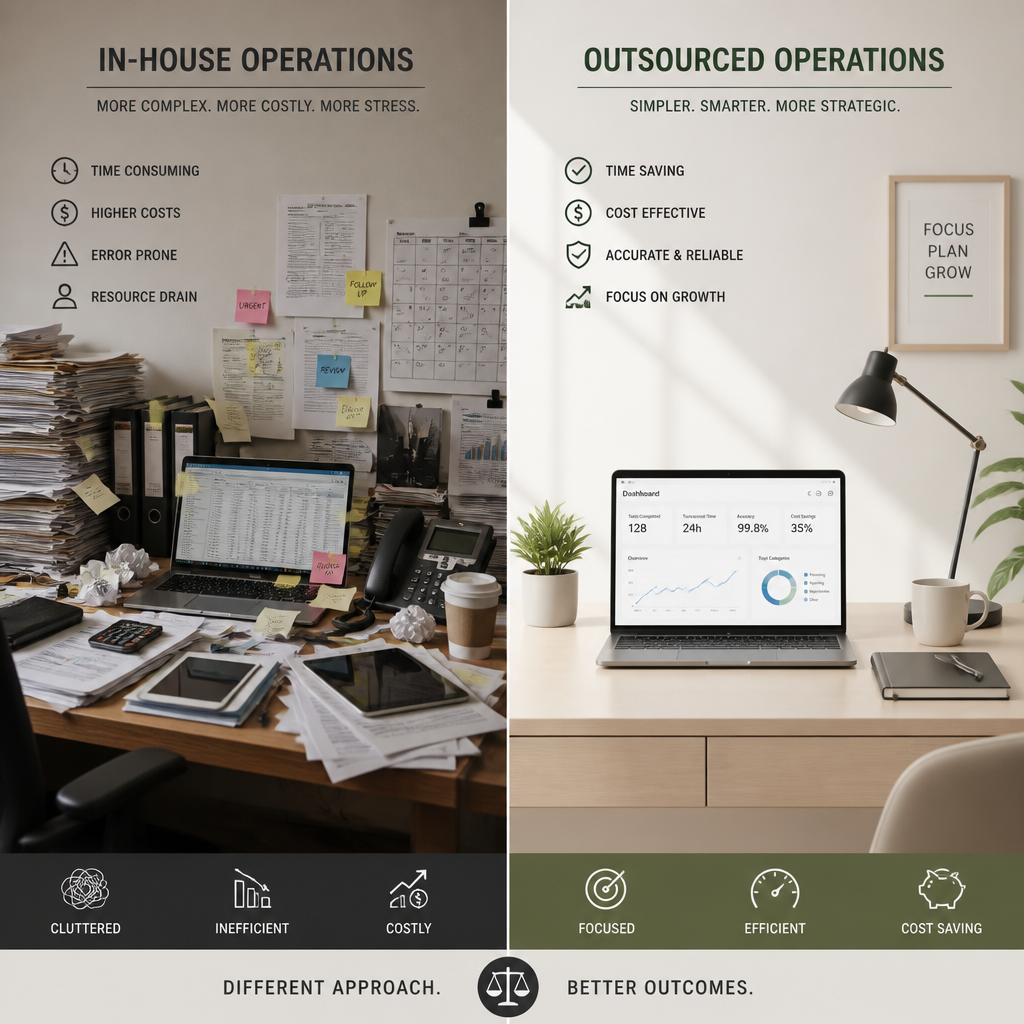
There is also a less obvious cost: the coverage gap. A two-person in-house team must cover annual leave, sick leave, and personal development time. During those periods, the business is effectively running with reduced or no IT support. An outsourced IT support provider absorbs that variability within its own team structure, maintaining consistent service levels regardless of individual staff availability.
What a Virtual IT Department Actually Delivers
The term “virtual IT department” is sometimes used loosely, so it is worth being precise about what a well-structured outsourced IT department model includes in practice.
Rapid Response Helpdesk
When a user cannot print, access a shared drive, or connect to a business application, the immediate requirement is a fast, knowledgeable response. A managed provider operating a structured helpdesk resolves the majority of issues remotely, with escalation paths and SLA commitments that define maximum response and resolution times in writing. This is categorically different from the informal arrangement most SMEs operate when a single internal hire manages everything from hardware procurement to password resets.
Proactive Monitoring and Maintenance
Reactive IT support, where action is taken only after something fails, is the model most SMEs default to with in-house staff because proactive monitoring requires specialist tooling and the operational discipline to act on alerts. A managed provider runs continuous monitoring across servers, endpoints, and network infrastructure, identifying degrading hardware, failed backups, or suspicious traffic before those conditions become outages. This approach measurably reduces unplanned downtime.
Strategic IT Reviews
A virtual IT department model replaces the need for a part-time or full-time IT Director by providing structured, senior-level input on technology direction. Quarterly business reviews examine infrastructure performance, licensing costs, security posture, and planned growth to ensure that the IT environment is built for where the business is going, not simply maintained for where it has been. This is the element most consistently absent from reactive, single-hire arrangements.
Pro tip: When evaluating any outsourced IT support provider in London, ask specifically for the agenda template used in their quarterly technology reviews. A provider that cannot produce one is unlikely to deliver genuine strategic input, regardless of what the proposal document states.
Outsourced IT Services and Cyber Security
Cyber security represents one of the clearest capability gaps between an in-house generalist and a managed services provider. According to reported figures, 43 percent of UK SMEs experienced a cyberattack in the prior year, with London businesses cited as disproportionately targeted given the concentration of financial and professional services activity in the capital.
Keeping a small internal team fully current on threat intelligence, compliance obligations, and evolving attack techniques is genuinely difficult. The risk of a knowledge gap forming is high when security expertise sits with one or two people who are also responsible for day-to-day user support and infrastructure maintenance. An outsourced IT services provider with a dedicated security function can offer managed detection and response, dark web monitoring, and structured vulnerability assessment, capabilities that require specialist tooling and expertise that most SMEs cannot justify funding internally.
The question is not whether a cyber incident will affect a London SME, but whether the business has the monitoring and response capability in place when it does. A single generalist hire, however capable, cannot provide the 24-hour coverage that meaningful threat detection requires.
Compliance requirements add a further dimension. Businesses handling personal data operate under UK GDPR obligations. Those in financial services face FCA expectations around operational resilience. A managed IT provider familiar with these frameworks ensures that technical controls, such as access management, encryption standards, and audit logging, are maintained continuously rather than reviewed only when an incident prompts attention.

Cloud Management and Compliance
The majority of London SMEs now operate across at least one cloud platform, most commonly Microsoft 365 for productivity and communication, with Azure, AWS, or Google Cloud Platform serving infrastructure and application workloads. Managing these environments correctly, meaning licensing optimisation, access governance, backup configuration, and security baseline enforcement, requires platform-specific expertise that changes as vendors update their products.
An outsourced IT manager embedded within a managed services model maintains that expertise continuously. Internal hires must invest time in training and certification to maintain equivalent competence, and that investment competes directly with their daily operational workload. In practice, cloud environments managed by stretched in-house teams frequently accumulate misconfigured settings, unused licences, and unpatched vulnerabilities simply because there is no dedicated capacity to review them systematically.
Microsoft 365 Administration in Practice
Microsoft 365 administration is a specific example where the gap between competent management and adequate management has measurable consequences. Proper administration includes conditional access policies, multi-factor authentication enforcement, mailbox security, Teams governance, SharePoint permission auditing, and licence assignment reviews. Each of these tasks requires regular attention. A managed provider handles them within an established operational cadence, whereas an internal hire typically addresses them reactively when a problem surfaces.
In-House vs. Outsourced vs. Hybrid: A Direct Comparison
The following table compares three IT delivery models across the criteria most relevant to London SMEs making this decision. The hybrid model, where one internal IT coordinator works alongside an outsourced IT support provider, is increasingly common for businesses that prefer a visible internal point of contact without bearing the full cost of a complete internal team.
| Criterion | In-House IT Team | Outsourced IT Department | Hybrid Model |
|---|---|---|---|
| Annual cost (50-user SME) | £78,000 to £121,000 for one to two staff, before tooling | Predictable per-user monthly fee, typically lower total cost | Coordinator salary plus managed service fee; moderate cost |
| Coverage hours | Business hours only; limited holiday and sick cover | Defined SLA hours; extended and 24/7 options available | Internal coverage during business hours; provider covers extended hours |
| Depth of expertise | Limited to individual staff skill sets; generalist risk | Multi-discipline team including security, cloud, and network specialists | Coordinator handles day-to-day; provider handles specialist requirements |
| Scalability | Requires new recruitment; 3-to-6 month lead time per hire | Immediate; contract adjusted as headcount changes | Moderate; provider absorbs growth without additional internal hiring |
| Strategic IT input | Requires a senior hire (IT Manager or Director) at substantial additional cost | Included via scheduled reviews with senior engineers | Depends on coordinator seniority; provider supplements strategic guidance |
| Cyber security capability | Limited; generalist awareness only in most SME teams | Dedicated security monitoring, compliance support, and incident response | Provider delivers security function; coordinator manages access and policy |
| Business continuity risk | High key-person dependency; single hire creates critical vulnerability | Low; team coverage eliminates single-person dependency | Reduced; provider continuity covers coordinator absence |
Choosing an Outsourced IT Support Provider in London
The market for outsourced IT support London contains providers ranging from sole traders offering break-fix support to fully structured managed services operations with dedicated helpdesks, security operations, and cloud practices. The differences between them matter significantly, and the proposal document alone rarely reveals them.
What the Contract Should Specify
A credible managed IT services agreement will define response time commitments by incident severity, specify the escalation path from first-line helpdesk to senior engineer, and state clearly which services are included in the base fee versus charged additionally. Vague language around “best efforts” or “reasonable response” in a contract is a reliable indicator that enforcement will be difficult when performance falls short.
Engineer Seniority and Access to Specialists
A common structural weakness in smaller IT support arrangements is that day-to-day support is handled by junior technicians, with senior engineers involved only on escalation. For an SME operating in a regulated environment or managing a complex cloud infrastructure, routine access to senior-level engineers is not optional. When evaluating providers, establish specifically which tier of engineer will handle initial responses and what triggers escalation to a more experienced resource.
Transparent Pricing and Quarterly Reviews
Transparent, fixed monthly pricing eliminates the unpredictability that makes IT a difficult line item to manage. Equally, a provider that conducts structured quarterly technology reviews is demonstrating a commitment to optimising the IT environment over time rather than simply maintaining it. These reviews should produce a written output, including a technology roadmap, a security posture summary, and recommendations aligned with business priorities, rather than a verbal update in a brief call.
Pro tip: Request a sample quarterly review report from any provider you are seriously evaluating. The document should contain specific findings about your environment type, not a generic template. If the provider cannot or will not share an anonymised example, that is informative in itself.
iTO.London structures its managed IT service around exactly this model: a dedicated helpdesk with defined SLAs, proactive monitoring, cloud environment management across Microsoft 365, Azure, AWS, and GCP, and quarterly technology reviews conducted by senior engineers. For London SMEs evaluating whether to maintain, restructure, or fully outsource their IT function, a direct conversation with the iTO.London team is a practical starting point. The company’s full range of managed IT services is documented in detail for businesses that want to assess scope before making contact.
Frequently Asked Questions
What is an outsourced IT department?
An outsourced IT department is a managed services arrangement in which an external provider assumes full responsibility for an organisation’s IT function, including helpdesk support, infrastructure monitoring, cloud management, cyber security, and strategic IT planning. The business receives the equivalent of an internal IT team without employing the staff directly, paying instead a predictable monthly fee defined by the scope of services and number of users.
How much does outsourced IT support cost for a London SME?
Pricing varies by scope and provider, but managed IT services in the UK are commonly structured as a per-user monthly fee. Comprehensive packages covering helpdesk, monitoring, patching, cyber security, and backup are typically available in a range that compares favourably against the fully loaded cost of equivalent in-house staffing. The key comparison is not against a bare salary figure but against the total employment cost including NI, pension, recruitment, training, and tooling.
What is the difference between outsourced IT support and a break-fix model?
A break-fix model charges for IT support only when something fails, with no ongoing monitoring or preventative maintenance. Outsourced IT support under a managed services model includes proactive monitoring, regular patching, and structured reviews designed to prevent failures before they occur. For most SMEs, the break-fix model produces higher total costs over time because unplanned outages and reactive emergency fees accumulate unpredictably.
Can an outsourced IT manager replace an internal IT Director?
For most SMEs, yes. A senior-level outsourced IT manager provides strategic technology guidance, vendor management, and technology roadmapping, which are the core responsibilities of an internal IT Director, without the associated employment cost, which in London typically represents a significant salary investment. The outsourced model delivers that seniority as part of a broader team structure rather than as a single point of dependency.
How do I know if my current IT support arrangement is adequate?
The most reliable indicators of an inadequate arrangement are recurring unresolved issues, the absence of proactive monitoring and patching, no written SLA governing response times, and no structured conversation about technology strategy. If IT issues are consistently interrupting operations, or if the business has not had a formal review of its security posture and cloud environment in the past 12 months, the current arrangement is likely costing more in lost productivity than a managed alternative would cost in fees.
Is outsourced IT support suitable for start-ups or only established businesses?
Outsourced IT support is well suited to start-ups because it provides immediate access to a full-function IT team from day one, without the lead time and cost of recruitment. It scales with the business: as headcount grows or cloud workloads expand, the service scope adjusts within the existing contract. Established businesses transitioning away from a legacy in-house arrangement also benefit because the provider can conduct an initial audit and remediate inherited problems before assuming ongoing management.
If you have evaluated the in-house versus outsourced decision for your business or have experience working with a managed IT provider in London, the team at iTO.London welcomes your perspective and any questions your evaluation has raised.
References
- In-depth analysis of true IT support costs for UK SMEs, including fully loaded staffing comparisons
- Side-by-side breakdown of in-house IT versus outsourced IT costs and capabilities for UK businesses
- Assessment of cyber security risks facing London SMEs and the case for outsourced IT support
- Practical overview of why London SMEs are moving to fully outsourced IT department models
- Comparative guide to outsourced versus in-house IT support for London SMEs covering key decision criteria