

Many London SMEs operate with IT arrangements that were never designed to scale: a single internal hire managing everything, a break-fix contractor called only when something fails, or a patchwork of separate suppliers with no single point of accountability. A virtual IT department resolves all three problems at once. It delivers the full capability of an in-house IT function, including helpdesk, infrastructure management, security, and strategic direction, through a managed service that operates to defined service level agreements (SLAs) and a predictable monthly cost. For businesses operating in or around the City of London, where regulatory expectations and operational tempo are particularly demanding, that model is increasingly the default choice.
Table of Contents
- What Is a Virtual IT Department?
- Quick Takeaways
- Why the City of London Raises the Bar for IT Support
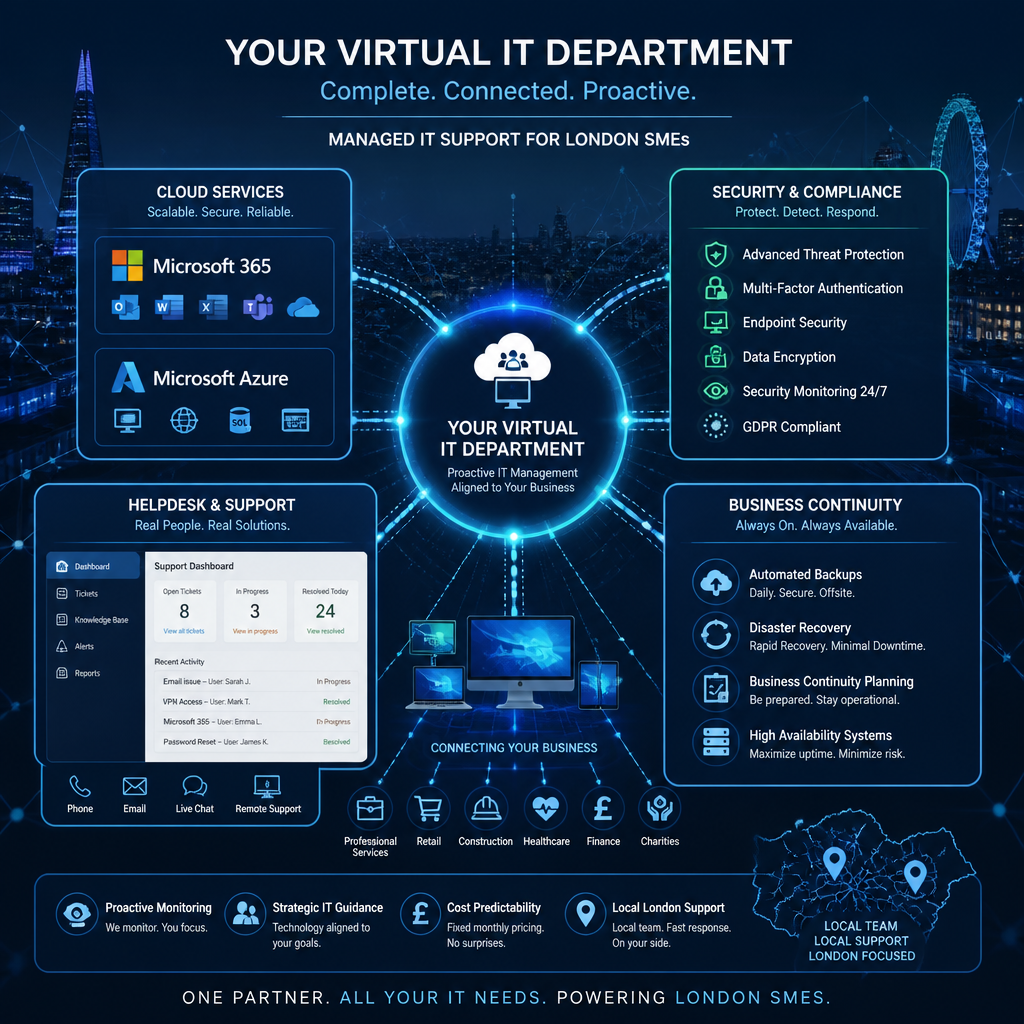
- Core Services Delivered by a Virtual IT Department
- In-House, Break-Fix, or Virtual IT Department: A Comparison
- How It Works in Practice for a London SME
- Security, Compliance, and the City of London
- Frequently Asked Questions
- References
What Is a Virtual IT Department?
A virtual IT department is a managed service in which an external provider assumes full responsibility for a business’s IT function. It is not simply a helpdesk contract. The model spans daily operational support, proactive monitoring and maintenance, cloud platform management, cyber security, and strategic technology planning, delivered by a team of senior engineers working to agreed response times and performance metrics.
The distinction from a standard IT support contract is important. A break-fix arrangement responds to problems after they occur. A virtual IT department is structured to prevent those problems in the first place, then resolve the ones that do arise quickly and without passing the cost of resolution back to the business. The service operates as the client’s IT department, not as an external supplier fixing isolated tickets.
For a London SME with between ten and two hundred users, the economics are straightforward. Recruiting, retaining, and managing even a small internal IT team carries significant overhead. A virtual IT department provides broader expertise, around-the-clock monitoring, and senior-level input at a cost that is typically lower than maintaining equivalent in-house capability.
Outsourcing IT no longer just means a helpdesk for password resets. A managed IT services provider can now cover everything an internal department used to, often for less than the cost of a single salary.
Quick Takeaways
| Key Insight | Explanation |
|---|---|
| A virtual IT department replaces, not supplements, internal IT | It covers helpdesk, monitoring, security, cloud management, and strategic reviews under a single managed contract. |
| Proactive monitoring prevents most outages before they occur | Continuous monitoring of servers, endpoints, and networks allows issues to be caught and resolved before staff notice any disruption. |
| City of London businesses face elevated compliance obligations | FCA-regulated firms, legal practices, and financial services companies require IT arrangements that meet specific data governance and security standards. |
| SLAs create measurable accountability | Defined response and resolution times mean IT performance is contractually guaranteed, not left to best efforts. |
| Microsoft 365 and cloud management are central to modern IT support | Most London SMEs rely on cloud platforms. A virtual IT department manages licensing, configuration, security, and ongoing optimisation. |
| Quarterly technology reviews align IT with business direction | Regular strategic sessions ensure the IT environment evolves alongside the business rather than lagging behind it. |
| Predictable monthly pricing removes budget uncertainty | Fixed per-user or per-seat pricing makes IT costs foreseeable, which simplifies financial planning for SME owners and directors. |
The following sections examine each of these points in depth, with particular reference to the operating context of City of London businesses and how a well-structured managed IT service addresses their specific requirements.

Why the City of London Raises the Bar for IT Support
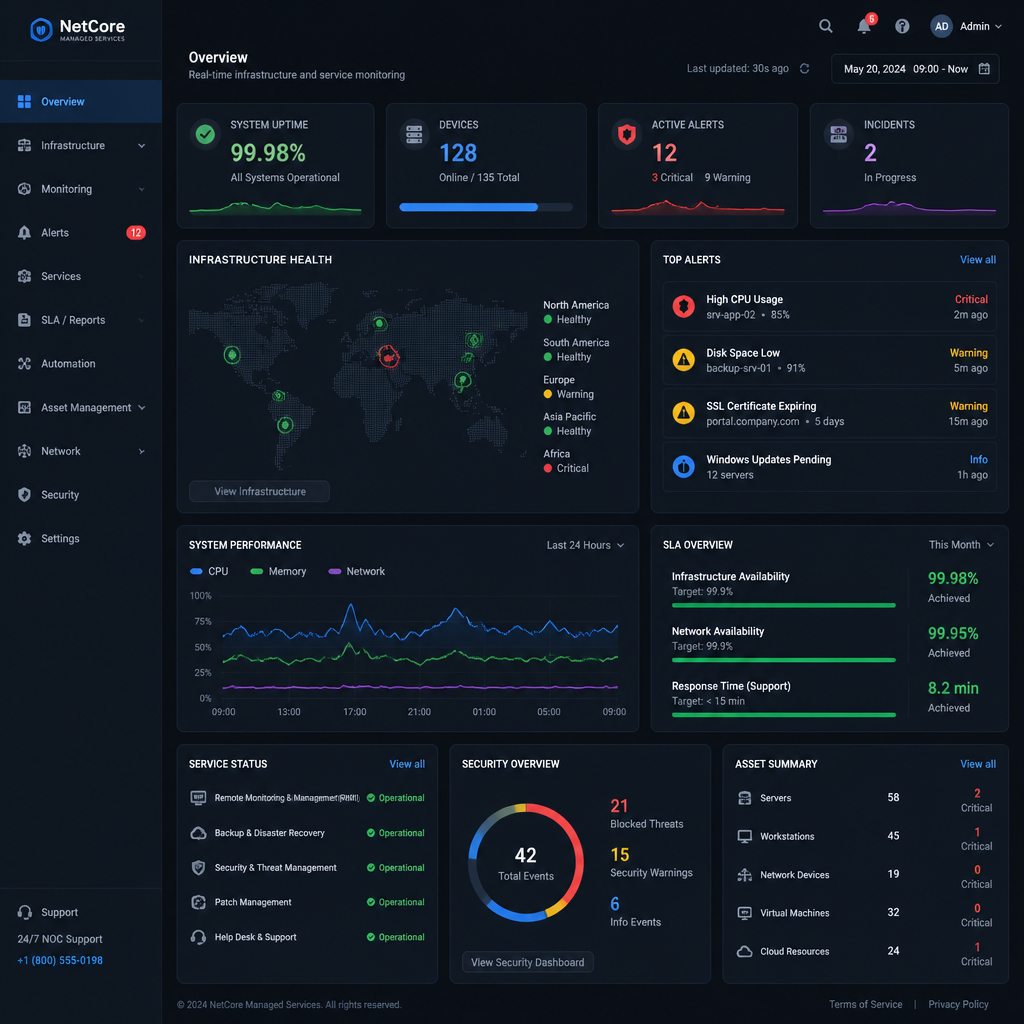
The Square Mile is home to a concentration of financial services firms, legal practices, insurance companies, and professional services organisations that share a common characteristic: their operations are highly dependent on IT, and the consequences of failure are disproportionately severe. A system outage during trading hours, a data breach involving client information, or a compliance gap identified during audit carries material financial and reputational cost.
IT support in the City of London therefore operates against a higher baseline requirement than equivalent support in a general commercial context. Infrastructure must meet the standards expected by regulators such as the Financial Conduct Authority. Data handling must satisfy GDPR and, depending on the firm’s work, sector-specific requirements around data retention and access controls. Cyber security posture must be demonstrably robust, with evidence available on request.
The Limitations of Reactive IT in a High-Stakes Environment
A reactive support model, where IT assistance is sought only when something breaks, is poorly matched to this environment. Downtime that is resolved within hours may still cause significant disruption to client-facing operations or time-sensitive financial processes. A virtual IT department, with its emphasis on continuous monitoring and preventive maintenance, is structurally better suited to the pace and risk profile of City businesses.
The geographic density of the City also matters practically. Many managed IT providers serving London SMEs offer rapid on-site response as part of their SLA, which is a meaningful advantage when a hardware failure or network issue cannot be resolved remotely and the business is located in EC2 or EC3.
Pro tip: When evaluating IT support in the City of London, ask prospective providers to specify their average remote response time and their guaranteed on-site response time separately. Those two figures tell you more about operational capability than any marketing description.
Core Services Delivered by a Virtual IT Department
Understanding what a virtual IT department actually does on a day-to-day basis is the most direct way to assess whether the model fits a given business. The services are not abstract. They are operational functions that the business currently handles through some combination of internal effort, external contracts, or managed absence.
Helpdesk and User Support
The helpdesk function provides staff with a direct point of contact for IT issues, from password resets and software faults to connectivity problems and device configuration. A well-run virtual IT department operates this service with defined response tiers: critical issues are escalated immediately, standard requests are handled within agreed timeframes, and all tickets are tracked and reported against SLA targets.
In practice, a rapid-response helpdesk removes the cost of lost staff time. When an employee cannot resolve an IT problem independently, every minute spent attempting to do so is a direct productivity loss. The helpdesk absorbs that cost before it compounds.
Proactive Monitoring and Maintenance
Continuous monitoring of servers, endpoints, network devices, and cloud platforms means that most failures are identified before they become visible to end users. Disk health, memory utilisation, security patch status, and backup integrity are monitored automatically. Where a threshold is crossed, the management team is alerted and acts without waiting for the client to raise a support ticket.
Scheduled maintenance windows, patch management cycles, and software updates are managed proactively, ensuring that the environment remains current and secure without requiring business owners to track vendor release schedules or organise update deployments themselves.
Cloud System Management
Most London SMEs now operate substantially within cloud platforms, most commonly Microsoft 365, and increasingly Azure, AWS, or Google Cloud Platform. A virtual IT department takes full operational responsibility for these environments: licensing, user provisioning, security configuration, compliance settings, and ongoing optimisation are all managed as part of the service.
Pro tip: Many SMEs pay for Microsoft 365 licences that are either unused or misconfigured, which creates both cost waste and security gaps. Ask your IT provider to conduct a licence audit as part of any onboarding review. The savings often offset a significant portion of the monthly support cost.
Security and Threat Management
Cyber security is not a separate product layer in a well-designed virtual IT department. It is embedded throughout. Endpoint detection and response, email filtering, multi-factor authentication enforcement, and regular vulnerability assessments are managed as standard components of the service, not optional add-ons invoiced separately.
In-House, Break-Fix, or Virtual IT Department: A Comparison
Business owners frequently approach this decision by comparing what they currently spend on IT against a quoted managed service price, without accounting for the full scope of what each model delivers. The table below provides a structured comparison across the dimensions that matter most to a London SME.
| Dimension | In-House IT Team | Break-Fix / Ad Hoc Support | Virtual IT Department |
|---|---|---|---|
| Cost structure | Fixed salary, NI, benefits, training, equipment | Variable, per-incident billing | Fixed monthly fee per user or seat |
| Coverage depth | Limited by headcount and skills of individuals hired | Reactive only; no strategic input | Full function: helpdesk, monitoring, cloud, security, strategy |
| Proactive monitoring | Possible but often deprioritised under operational pressure | None | Continuous, automated, with escalation protocols |
| Strategic input | Available if a senior IT manager is retained | None | Quarterly technology reviews and virtual IT director input |
| SLA accountability | Internal only; no contractual guarantee | Rarely formalised | Contractually defined response and resolution targets |
| Scalability | Requires recruitment to scale up | Scales in cost, not in capability | Scales with the business; user count adjusts monthly |
| Resilience | Single point of failure if key person leaves | Dependent on availability of chosen contractor | Team-based; no single point of failure |
The comparison makes clear that the virtual IT department model is not simply a cheaper version of in-house IT. It is a structurally different arrangement that addresses the limitations of both the in-house and break-fix approaches simultaneously.
How It Works in Practice for a London SME
The transition to a virtual IT department typically follows a structured onboarding process. An initial discovery phase maps the existing environment: hardware, software, licences, cloud tenants, network configuration, and security posture. This produces a baseline from which gaps are identified and a remediation roadmap is developed.
From that point, the virtual IT department operates in the background. Staff raise support requests through a helpdesk portal, by email, or by telephone. Issues are triaged, assigned, and resolved. Monthly reporting provides visibility into ticket volumes, response time performance against SLA, and any recurring issues that warrant systemic resolution rather than repeated individual fixes.
Quarterly Technology Reviews
One of the most significant differences between a virtual IT department and a conventional support contract is the inclusion of regular strategic reviews. Each quarter, the client meets with a senior engineer or virtual IT director to review the technology environment, assess upcoming changes in the business, and align the IT roadmap with operational priorities.
For a growing SME, this is a meaningful function. Decisions about new software adoption, remote working infrastructure, cloud migration, or hardware refresh cycles benefit from informed, independent input. The quarterly review provides that input without requiring the business to employ a full-time IT director.
Joiner, Mover, and Leaver Processes
A common and frequently underestimated operational burden for London SMEs is the management of IT access as staff join, move between roles, or leave the business. Each transition requires account provisioning or de-provisioning across multiple systems, device configuration, and access rights adjustment. When managed inconsistently, this creates both security exposure and operational friction.
A virtual IT department manages this process to a defined standard, ensuring that new starters are productive from day one and that leavers are cleanly offboarded without leaving residual access to company systems.
Pro tip: Residual access from former employees is one of the most common sources of preventable security incidents in SMEs. A formal joiner-mover-leaver process, enforced through your IT support arrangement, removes this risk systematically.
Security, Compliance, and the City of London
Small and medium-sized businesses in the City of London are increasingly targeted by cyber criminals precisely because they are perceived as having weaker defences than the larger institutions they work alongside. The City of London Corporation has noted that SMEs risk financial loss, data breaches, reputational damage, and operational disruption without the right cyber security knowledge and support.
Cyber Essentials certification is a practical starting point for many London SMEs. It demonstrates a baseline level of security hygiene and is increasingly required by clients and partners in financial and professional services sectors. A well-structured virtual IT department manages the technical controls required for Cyber Essentials compliance as part of standard operations, rather than treating certification as a separate project.
GDPR and Data Governance
Data governance obligations under GDPR are not one-time compliance exercises. They require ongoing attention to how personal data is stored, processed, transmitted, and deleted across all systems. A virtual IT department ensures that the technical infrastructure supporting data handling meets the required standards, and that changes to the environment, such as moving to a new cloud platform or adopting a new application, are assessed for data protection implications before deployment.
FCA-Regulated Businesses
For firms operating under FCA regulation, IT arrangements carry additional significance. Operational resilience requirements, including the ability to maintain critical business services through disruption, are now an explicit regulatory expectation. A virtual IT department with documented monitoring, incident response, and disaster recovery procedures provides a defensible position when regulators ask how the business manages IT risk.
Frequently Asked Questions
What does a virtual IT department actually include?
A virtual IT department typically includes a rapid-response helpdesk, proactive monitoring and maintenance, cloud platform management (such as Microsoft 365 and Azure), cyber security services, joiner-mover-leaver administration, and regular strategic reviews. The exact scope varies by provider and service tier, so it is worth confirming the full list of inclusions before signing a contract.
How is IT support in the City of London different from general IT support?
The City of London contains a high density of regulated businesses in financial services, legal, and insurance sectors. IT support in this context must be designed with FCA compliance, GDPR, data governance, and operational resilience requirements in mind. Providers serving City businesses should have direct experience with these obligations rather than a generic approach applied to all sectors.
Is a virtual IT department suitable for a business with fewer than twenty employees?
Yes. In fact, smaller businesses often benefit most from the model. A twenty-person firm cannot justify the cost of an in-house IT function, yet its IT requirements, security obligations, and reliance on cloud systems are substantial. A virtual IT department provides enterprise-grade coverage at a cost that scales with headcount rather than requiring a minimum internal investment.
How long does it take to onboard a virtual IT department?
A structured onboarding typically takes two to four weeks, depending on the complexity of the existing IT environment and the number of users. During that period, the provider conducts a full IT audit, migrates any helpdesk processes, configures monitoring tools, and establishes baseline security settings. The business should experience minimal disruption during this transition.
What SLAs should a London SME expect from a virtual IT department?
At a minimum, expect defined response times for different priority levels: critical issues affecting business operations should receive a response within one hour, with active resolution underway. Standard requests should be acknowledged within four hours. Any provider unwilling to formalise these commitments contractually should be treated with caution, as unmeasured service cannot be held accountable.
Can a virtual IT department support remote and hybrid working arrangements?
Yes, and in practice this is one of the strongest arguments for the model. A virtual IT department is configured to support users wherever they work, managing secure remote access, device management, cloud application access, and endpoint security across distributed teams without requiring staff to be in a central office to receive support.
How does iTO.London deliver the virtual IT department model for London SMEs?
iTO.London provides a complete managed IT service designed specifically for London SMEs, covering rapid-response helpdesk support, proactive monitoring and maintenance, Microsoft 365 and Azure management, security and compliance solutions, and quarterly technology reviews. The service is delivered by senior engineers with transparent, predictable pricing and measurable SLAs, operating as an outsourced IT department rather than a conventional support contractor. Businesses can explore the full service range at iTO.London’s managed IT services page.
If your business is currently managing IT reactively or questioning whether your existing IT arrangement is delivering measurable value, we welcome your perspective. What has prompted the search for a more structured IT support model, and what gap in your current arrangement matters most?
References
- City of London Corporation guidance on cyber security support for small and medium-sized businesses
- Analysis of why London SMEs are outsourcing their complete IT function to managed service providers
- Outsourced IT support versus in-house IT: a practical guide for London SMEs in 2026
- Managed IT support and cyber security services for City of London financial sector clients