
Most London SMEs manage their technology reactively, responding to failures and purchasing software as needs arise, without a coherent plan connecting IT investment to business outcomes. The result is fragmented systems, avoidable downtime, and mounting costs that are difficult to justify. IT strategy consulting addresses this directly: it translates business goals into a structured technology roadmap that gives every IT decision a purpose and a measurable return. This guide sets out the key elements of a sound IT roadmap for small businesses in London, the questions a good consultant should ask, and the practical steps that transform technology from a recurring overhead into a source of competitive advantage.
Table of Contents
- What Is IT Strategy Consulting?
- Why London SMEs Need an IT Roadmap
- Building Your IT Roadmap: The Core Components
- Choosing an IT Strategy Consultant in London
- Roadmap Approaches Compared
- Common Mistakes London SMEs Make When Planning IT
- Frequently Asked Questions
- References
What Is IT Strategy Consulting?
IT strategy consulting is the structured process of aligning a business’s technology decisions with its commercial objectives. A consultant examines the current technology estate, identifies gaps and risks, and produces a prioritised roadmap that connects each planned investment to a specific business outcome: faster operations, better security, reduced cost, or improved scalability.
For small businesses, this differs from standard IT support. Support keeps existing systems running. Strategy determines what systems should exist in the first place, when they should change, and what return the business should expect from each pound invested. The two services are complementary, but conflating them is a common and costly mistake.
The UK strategy consulting market is expanding rapidly. Nearly 60% of British business leaders now recognise that urgent digital upgrades are vital to competitiveness. For London SMEs competing in a dense, high-cost environment, having a clear technology strategy is no longer optional.
Why London SMEs Need an IT Roadmap
A technology roadmap is a rolling, structured plan that sets out what IT investments a business will make, in what sequence, and to what end. An IT roadmap helps small businesses plan technology investments in a structured way, ensuring that systems support business goals while reducing unnecessary risks and expenses.
Without a roadmap, IT spending becomes reactive. Hardware is replaced when it fails rather than before it fails. Software is purchased because a supplier recommended it rather than because it solves a defined problem. Security patches are applied late, if at all. Each of these patterns increases cost and exposure without improving capability.
London businesses face additional pressures. Office space costs, a competitive labour market, and clients who expect digital-first engagement all increase the stakes of poor technology decisions. A well-constructed IT roadmap reduces those risks and makes technology choices defensible to boards, investors, and auditors.
UK SMB IT spending is forecast to grow 6.1% year-on-year through 2029, rising from approximately $70bn in 2025 to $74bn in 2026. Businesses that plan this spending strategically will extract better outcomes than those that do not.

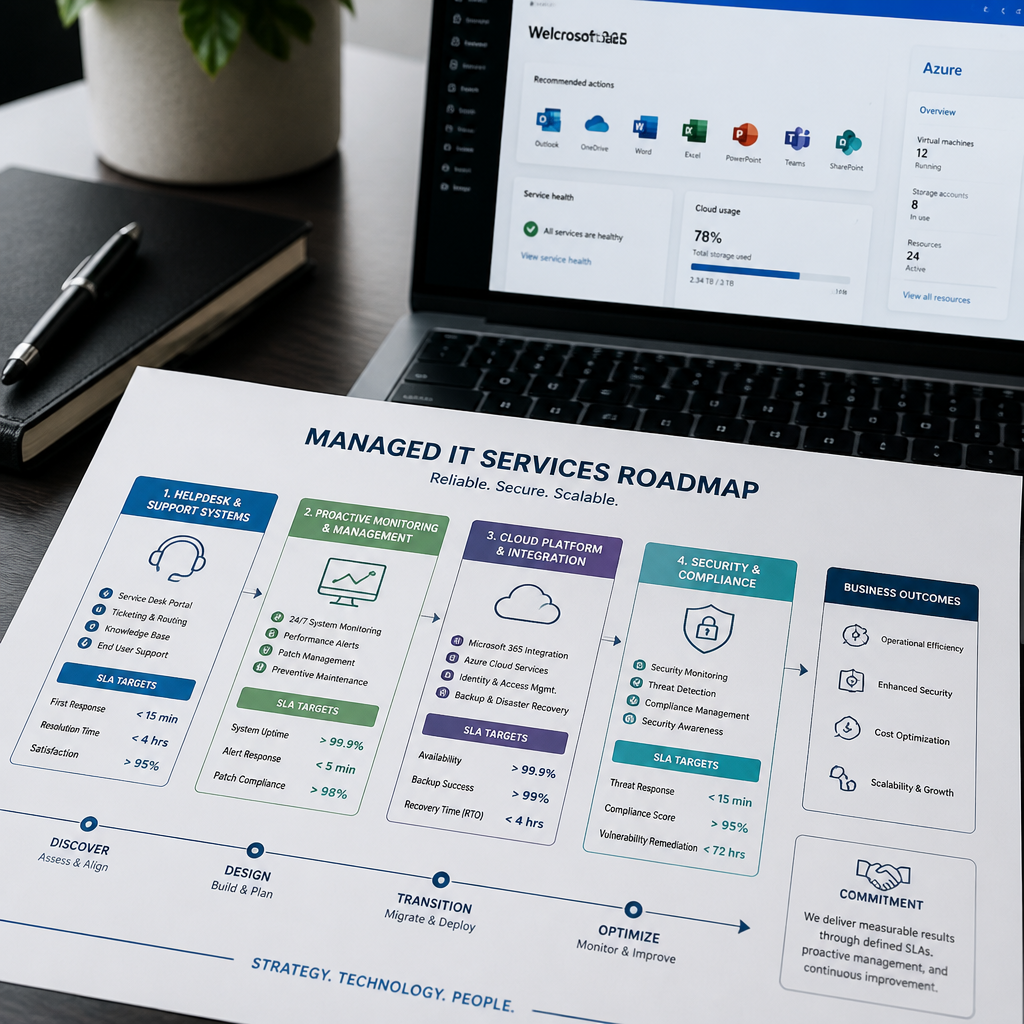
Building Your IT Roadmap: The Core Components
A practical roadmap for a London SME does not need to be complex. The strongest versions usually include six connected components, even if the format is kept simple. What matters is that each component connects to a real business decision rather than existing as a theoretical exercise.
1. Current-State Assessment
Before planning future investments, a business must understand what it currently has. This means a full audit of hardware (including end-of-support dates), licensed software, cloud subscriptions, network infrastructure, and data storage arrangements. In practice, most SMEs discover they are paying for unused licences, running hardware that is outside vendor support, or storing sensitive data in locations that do not meet their obligations under UK data protection law.
The assessment should also document dependencies: which systems rely on which, and what the business impact would be if each one failed. This shapes the prioritisation of the roadmap that follows.
2. Strategic Alignment
Strategic alignment means linking each technology decision to something the business is trying to achieve. For a professional services firm growing its client base, the priority might be scalable collaboration tools and a robust client data platform. For a manufacturer modernising operations, it might be integrating existing systems to reduce manual data entry. The starting point is always the business plan, not the technology catalogue.
3. Security and Compliance Baseline
Any roadmap that does not address security is incomplete. With official statistics showing more than a third of small businesses suffered a cyber attack in a recent year, the NCSC urges them to make use of its Cyber Action Plan and Check Your Cyber Security tools. The NCSC’s Cyber Essentials certification provides a recognised minimum standard and is increasingly required by clients and public sector procurement frameworks.
For London SMEs handling personal data, the ICO’s guidance on UK GDPR compliance should inform how data storage, access controls, and breach response procedures are built into the roadmap. Security and compliance are not a separate workstream: they are embedded in every other decision.
Pro tip: Complete the NCSC’s free Check Your Cyber Security assessment before any roadmap planning session. It takes under an hour and identifies the gaps that most commonly lead to incidents in businesses of your size.
4. Cloud and Infrastructure Planning
A workable technology roadmap needs structure to avoid becoming either too vague to guide decisions or too detailed to maintain. The infrastructure section should specify which workloads will move to cloud platforms such as Microsoft 365, Azure, AWS, or Google Cloud, and which will remain on-premises, with a clear rationale for each choice. It should also address backup, disaster recovery, and network resilience.
For most London SMEs, a hybrid model is the practical outcome: Microsoft 365 for productivity and communication, a cloud-hosted line-of-business application, and on-premises infrastructure only where latency or regulatory requirements make cloud unsuitable.
5. Budget Phasing and Prioritisation
The structure that works in practice is a rolling three-year plan reviewed quarterly and rebuilt annually. Year one is committed and detailed. Year two is planned to the half-year with costs at roughly 20% confidence. Year three is directional. This gives the business financial certainty for near-term decisions while preserving flexibility as technology and business conditions evolve.
6. Governance and Review Cadence
A roadmap without a review process becomes obsolete within months. Effective governance means quarterly reviews of progress against the plan, annual rebuilds of the three-year horizon, and a defined escalation path when unplanned events (a security incident, a rapid headcount increase, a merger) require the plan to change. Many London SMEs find that a quarterly technology review with a managed IT partner, rather than an internal committee, is the most efficient way to maintain this discipline.

Choosing an IT Strategy Consultant in London
An IT strategy consultant in London should be able to demonstrate a track record with businesses of comparable size and complexity, not just with large enterprises. The skills required are different: a consultant who has spent a career advising FTSE 250 companies will not necessarily understand the constraints of a 30-person professional services firm with a three-person finance team and no internal IT resource.
The most useful arrangement for most London SMEs is a managed IT services provider that offers strategic planning as part of its service, rather than a standalone consulting engagement. A provider that also manages the infrastructure has a direct commercial incentive to recommend only what is genuinely needed, because they will be responsible for operating it.
Technology strategy without operational accountability is just a document. The value is in the execution, the ongoing adjustment, and the measurement of outcomes against the original plan.
When evaluating any IT strategy consultant in London, ask for documented case studies from businesses of your size, a clear explanation of how recommendations are prioritised, and a description of what happens after the roadmap is delivered. A roadmap that sits in a shared drive is worth nothing.
Pro tip: Ask any prospective IT consultant to walk through a real example of a recommendation they did not make, and why. A credible consultant will be able to describe a situation where the right answer was to defer investment or retain an existing system rather than replace it.
Roadmap Approaches Compared
The table below summarises three common approaches to technology strategy consulting for London SMEs, with their practical trade-offs.
| Approach | Typical Format | Best Suited To | Key Risk |
|---|---|---|---|
| One-off consulting engagement | Fixed-term project delivering a written roadmap document | Businesses with a specific transformation trigger (merger, relocation, rapid growth) | No ongoing accountability; roadmap may not be implemented or reviewed |
| Managed IT with embedded strategy | Ongoing managed services contract including quarterly technology reviews | SMEs without internal IT resource seeking a virtual IT department | Dependent on provider quality; requires clear SLAs and defined scope |
| Fractional CTO or IT Director | Part-time senior resource attending leadership meetings and directing internal IT staff | Businesses with internal IT staff needing senior-level direction | Higher cost; requires internal IT team to execute recommendations |
For the majority of London SMEs with fewer than 100 staff and no dedicated IT department, the managed IT with embedded strategy model delivers the best combination of cost, accountability, and continuity. It provides access to senior-level thinking without the overhead of a full-time hire, and it keeps the strategy connected to day-to-day operational reality.
Common Mistakes London SMEs Make When Planning IT
The most common mistake is treating the IT roadmap as a technology document rather than a business document. When IT planning is driven by vendor recommendations or internal IT preferences rather than business objectives, spending escalates and outcomes disappoint.
A second frequent error is underinvesting in the current-state assessment. Businesses that skip the audit phase and jump straight to planning routinely discover mid-project that a dependency they had not identified blocks the next step. The audit is not overhead: it is the foundation on which every subsequent decision rests.
Third, many SMEs plan without accounting for internal capacity. A migration to Microsoft 365, a new CRM deployment, or a security uplift all require staff time and management attention alongside the technical work. A roadmap that does not reflect the realistic capacity of the business to absorb change will stall at the first implementation stage.
Finally, if you work with an external IT partner, ask them to show dependencies in plain English. For example, “before moving telephony, confirm network readiness and resilience” is better than a generic “communications modernisation workstream”. Specificity is the test of a credible plan.
iTO.London’s approach as an outsourced IT department for London SMEs is built around avoiding precisely these errors: structured quarterly technology reviews, documented SLAs, and senior engineers who are accountable for both the strategy and its delivery. For businesses considering managed IT support in London, the starting point is a thorough assessment of the current technology estate before any roadmap is agreed.
Frequently Asked Questions
What does an IT strategy consultant actually do for a small business?
An IT strategy consultant assesses the current technology estate, identifies gaps between existing capability and business objectives, and produces a prioritised roadmap of investments. For small businesses, the most valuable output is usually clarity: a structured plan that makes IT spending decisions straightforward rather than contentious, and that allows the business to say no to unnecessary expenditure with confidence.
How long does it take to build an IT roadmap for a small business?
For a London SME with 10 to 100 employees, a credible initial roadmap typically takes four to six weeks to produce from the point of engagement. This includes the current-state assessment, stakeholder interviews, strategic alignment workshops, and the drafting of a phased three-year plan. The roadmap is then reviewed and updated quarterly as business conditions change.
How much does IT strategy consulting cost for a London SME?
Costs vary depending on scope and provider model. A standalone consulting engagement for a 50-person business might range from several thousand to tens of thousands of pounds depending on the depth of audit required. Managed IT services providers that embed strategy into an ongoing contract typically spread this cost across the monthly service fee, making it more predictable and accessible for businesses that cannot justify a large one-off spend.
What is the difference between an IT roadmap and an IT strategy?
An IT strategy defines the principles and priorities that govern technology decisions: what the business is trying to achieve with technology, and what constraints apply. An IT roadmap translates that strategy into a sequenced, time-bound plan of specific initiatives, investments, and milestones. The strategy answers “why” and “what”; the roadmap answers “when” and “how much”. Both are needed for effective technology planning.
Does a small business in London need ISO 27001 or Cyber Essentials certification?
Cyber Essentials is the recommended starting point for most London SMEs. It is a UK Government-backed scheme that addresses the most common cyber threats and is increasingly required by clients and public sector contracts. ISO 27001 is a more comprehensive standard that is appropriate when a business handles significant volumes of sensitive client data, operates in regulated sectors, or has specific contractual requirements. A good IT strategy roadmap will specify which standard is appropriate and when to pursue it.
Can a managed IT services provider replace a dedicated IT director?
For most SMEs with fewer than 50 to 75 staff, a managed IT services provider with senior-level engineers and a formal quarterly review process delivers the strategic oversight that a business needs without the cost of a full-time IT director. The provider takes responsibility for monitoring, security, cloud management, and roadmap planning. As the business grows, the two models are not mutually exclusive: an outsourced IT department can work alongside an internal technology lead as headcount justifies it.
How does technology strategy consulting differ from project-based IT consulting?
Project-based IT consulting is scoped to a specific outcome: migrating a server, deploying a new CRM, or implementing a security tool. Technology strategy consulting takes a broader view, examining how all technology decisions fit together over a multi-year horizon. The practical difference for a small business is that strategy consulting reduces the number of expensive project re-do’s, because each initiative is planned with its dependencies and successors already considered.
If your London business is ready to move from reactive IT management to a structured technology strategy, share your current challenges in the comments below or reach out to describe what a workable IT roadmap could look like for your specific situation.
We would love your feedback and any insights you would share with others. What perspective would you add?
References
- UK SMB IT spending trends and technology investment forecasts for 2026
- IT strategy consultancy for UK SMEs: what it involves and why it matters
- NCSC guidance on cyber security services for small organisations
- Building an IT roadmap: a UK business guide to aligning technology spend with strategy
- Core components of an effective SME technology roadmap