
For most London SMEs, the question is not whether IT leadership is needed, but what form it should take. A fractional CIO delivers senior-level strategic oversight at a fraction of the cost of a permanent hire, while a full-time CTO brings deep, dedicated expertise that only makes financial sense at a particular scale. Understanding which model fits your business, and at what stage, is a decision that directly affects technology costs, security posture, and growth capacity.
Table of Contents
- Defining the Roles: Fractional CIO, Virtual CIO, and Full-Time CTO
- Quick Takeaways
- The Real Cost Comparison
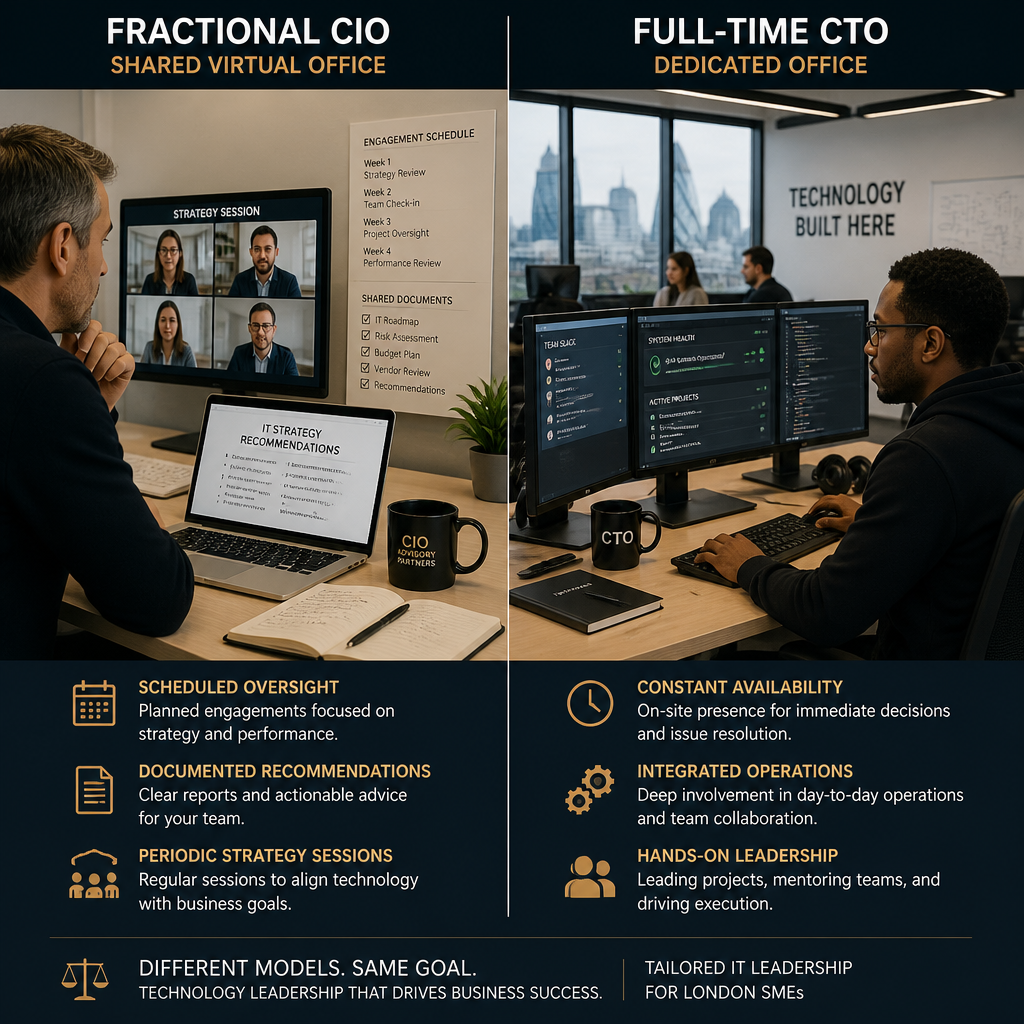
- What Each Model Actually Delivers
- Side-by-Side Comparison
- When Fractional Works, and When It Does Not
- How iTO.London Delivers Virtual IT Leadership for SMEs
- Frequently Asked Questions
- References
Defining the Roles: Fractional CIO, Virtual CIO, and Full-Time CTO
These three titles are often used interchangeably in vendor marketing, but they represent meaningfully different arrangements. Clarity on this point matters before committing to any model.
Fractional CIO
A fractional CIO is an independent executive engaged directly by your business on an ongoing retainer. Typical capacity runs between five and ten hours per week. Because they are not employed by a technology vendor, their recommendations on software, cloud platforms, and suppliers carry no commercial conflict of interest. They report to the CEO or board and focus on IT strategy, governance, vendor management, and technology investment decisions.
Virtual CIO (vCIO)
A virtual CIO, or vCIO, is usually a service bundled into a managed service provider’s support contract. The vCIO is employed by the provider itself, and their strategic input tends to be limited to quarterly reviews and account-level planning. While this model adds strategic context to day-to-day IT operations, it is important to recognise that the vCIO’s employer has a commercial interest in the technology you purchase. This is a different proposition from an independent fractional engagement.
Full-Time CTO
A full-time CTO is a permanent employee working a standard 40-hour week. This model delivers deep, continuous involvement in technology architecture, engineering leadership, and product development. The commitment is substantial in both cost and management overhead. For most London SMEs without an in-house engineering team, it represents a significant commitment that is difficult to justify on operational grounds alone.
Quick Takeaways
| Key Insight | Explanation |
|---|---|
| Fractional CIO retainers start around £2,000 per month in the UK | UK fractional CIO engagements range from roughly £2,000 to £8,500 per month depending on scope and days committed, compared to a full-time CIO whose total London employer cost frequently exceeds £170,000 per year. |
| A fractional CIO is independent; a vCIO is not | Fractional CIOs are hired directly and carry no vendor allegiance. A vCIO is employed by a managed service provider and may have incentives tied to the technology they recommend. |
| Full-time CTOs become cost-effective only at significant engineering scale | Once annual technology investment exceeds approximately £4 million, the fully loaded cost of a permanent CTO begins to pay for itself through architecture decisions and hiring leverage. Below that threshold, fractional nearly always wins on cost. |
| The fractional model carries lower mis-hire risk | A poorly matched full-time CTO hire can cost 12 to 18 months of lost momentum plus recruitment fees of £25,000 to £45,000. A fractional engagement can be reviewed and adjusted within a quarter. |
| Most London SMEs need IT strategy, not engineering leadership | The CTO role is most valuable when managing in-house engineering teams. SMEs without developers on staff typically need the governance and vendor oversight that a fractional CIO or managed IT partner provides. |
| Fractional CIO and managed IT support work best in combination | Strategic oversight from a fractional CIO paired with a managed IT services provider gives SMEs both executive direction and operational delivery, without the overhead of any full-time hires. |
| London rates sit at the upper end of the UK range | London-based senior fractional engagements command a premium over regional equivalents. Factor this into budgeting, and compare the cost against the total employer cost of a permanent hire, not just base salary. |
The sections below examine each model in practical terms, including where the cost comparison actually sits when all employment costs are accounted for.


The Real Cost Comparison
Salary figures in job listings are not the right basis for this decision. The true cost of a full-time executive includes employer National Insurance contributions, pension obligations, recruitment fees, benefits, and the cost of eventual replacement. When those items are totalled, the financial case for fractional IT leadership becomes considerably stronger than the headline salary figures suggest.
Full-Time CIO or CTO: Total Employer Cost in London
According to data from Glassdoor, the median total pay for a CIO in London currently sits at approximately £171,000 per year, with a total pay range spanning from around £112,000 to £283,000. A full-time CTO at a comparable seniority level carries an all-in employer cost, including salary, employer NI, pension, and recruitment fees, of between £140,000 and £230,000 per year. Recruitment alone, when using a retained search firm, typically costs £25,000 to £45,000 in year one.
Fractional CIO: What UK Retainers Actually Cost
UK fractional CIO retainers range from approximately £2,000 to £8,500 per month, depending on the number of days committed and the scope of the engagement. That translates to an annual cost of £24,000 to £102,000. There are no employer NI contributions, no pension obligations, no equity awards, and no notice period costs. A mid-range engagement at roughly £4,500 per month, covering a digital roadmap, vendor oversight, and monthly board input, costs around £54,000 per year, or approximately one-third of the mid-point full-time equivalent.
The financial case for fractional IT leadership rests not on the headline retainer rate but on the full loaded cost of the alternative. Once recruitment fees, employer contributions, and the risk of mis-hire are included, the gap between fractional and permanent widens considerably for businesses operating below significant engineering scale.
Pro tip: When evaluating the cost of any IT leadership model, always calculate the total employer cost of the permanent alternative, not the advertised salary. Include employer NI at current rates, pension auto-enrolment contributions, and a realistic estimate of recruitment fees. The resulting figure almost always strengthens the case for fractional engagement at SME scale.
What Each Model Actually Delivers
Cost is only one dimension. Each model has a distinct scope of work, and choosing the wrong one creates gaps that become visible quickly.
What a Fractional CIO Delivers
A fractional CIO brings strategic IT governance to a business that does not have a dedicated technology leader. In practice this means owning the technology roadmap, benchmarking supplier contracts, leading security and compliance oversight, advising on cloud platform decisions, and representing IT interests at board level. They do not manage helpdesk queues or configure infrastructure. Their value is in direction, not delivery.
For a London SME running Microsoft 365, moving workloads to Azure, or navigating GDPR and Cyber Essentials obligations, a fractional CIO provides the seniority to make those decisions correctly without committing to a permanent salary. Combined with a managed IT services partner handling day-to-day operations, this covers the full spectrum of IT leadership at a commercially rational cost.
What a Full-Time CTO Delivers
A full-time CTO is primarily valuable when a business is building or managing an in-house engineering team. Their day-to-day contribution is in technical architecture decisions, engineering hiring, developer team leadership, and product development governance. If an SME does not employ software engineers, a full-time CTO will spend much of their time without a natural domain to lead. The role is well-suited to technology companies, SaaS businesses, and scale-ups with dedicated development capacity.
The Overlap: Where Both Models Touch the Same Problems
Both a fractional CIO and a full-time CTO will address vendor selection, cloud strategy, cybersecurity governance, and technology budgeting. The difference is depth and continuity. A full-time CTO can go deep on technical architecture every day. A fractional CIO provides senior judgment on the same questions but on a scheduled basis, which is appropriate when those decisions occur monthly or quarterly rather than daily.
Side-by-Side Comparison
The following table compares the three most relevant models for a London-based SME considering an IT leadership decision in 2026.
| Criterion | Fractional CIO | Virtual CIO (vCIO via MSP) | Full-Time CTO |
|---|---|---|---|
| Typical annual cost (UK, 2026) | £24,000 to £102,000 | Bundled within MSP contract; not separately itemised | £140,000 to £230,000+ all-in |
| Independence from vendors | Fully independent | Employed by MSP; potential conflict of interest | Fully independent (as employee) |
| Typical time commitment | 5 to 10 hours per week | Quarterly reviews, ad hoc account calls | 40 hours per week |
| Reports to | CEO or board | MSP account manager or service lead | CEO or board |
| Employer NI and pension liability | None | None | Full employer obligations apply |
| Recruitment risk | Low; adjustable within one quarter | None; service is ongoing | High; mis-hire costs 12 to 18 months of momentum |
| Best fit for | SMEs needing IT strategy and governance without a permanent hire | SMEs seeking basic strategic context within an MSP relationship | Technology companies with in-house engineering teams |
| Engineering team leadership | Not the primary function | Not provided | Core function |
When Fractional Works, and When It Does Not
The fractional model is well-suited to the majority of London SMEs, but it has clear boundaries. Recognising those boundaries prevents businesses from either under-investing or over-investing in IT leadership.
Situations Where Fractional CIO Engagement Delivers Strong Results
A fractional CIO engagement works well when a business has grown to the point where IT decisions are materially affecting operations and commercial outcomes, but cannot justify, or does not need, a full-time executive. Common triggers include a planned migration to Microsoft 365 or a cloud platform, a pending security audit, a supplier contract renewal requiring technical scrutiny, a GDPR compliance review, or board pressure to articulate a credible technology strategy. In each of these cases, five to ten hours of senior IT judgment per week, consistently applied, produces measurable outcomes.
The model also suits businesses transitioning from a break-fix IT model to a managed services arrangement. A fractional CIO can define requirements, evaluate providers, and oversee the transition, then continue in a governance role once the managed IT function is operational.
Situations Where a Fractional CIO Is Insufficient
If a business is building a software product, managing a team of developers, or making daily architecture decisions on a complex engineering platform, five to ten hours per week is not enough. A full-time CTO is the appropriate model at that scale. Similarly, if a business needs continuous incident management or hands-on infrastructure work, that function belongs in a managed IT support contract rather than a strategic leadership retainer.
Pro tip: A common mistake is treating the fractional CIO and managed IT support as alternatives. They are complementary. The fractional CIO sets direction and holds suppliers to account. The managed IT partner delivers operational continuity. Running both in combination gives an SME a complete IT function without the costs of a permanent team.
How iTO.London Delivers Virtual IT Leadership for SMEs
iTO.London operates as an outsourced IT department for London-based SMEs. The service model combines senior-level engineering capability with the strategic oversight that smaller businesses have historically only been able to access by hiring a permanent executive.
The iTO.London service portfolio covers rapid-response helpdesk support, proactive infrastructure monitoring, cloud system management across Microsoft 365, Azure, AWS, and GCP, and security and compliance solutions aligned to frameworks including Cyber Essentials. Quarterly technology reviews provide the board-level reporting and strategic input that characterise a fractional CIO engagement, without the cost or complexity of hiring one separately. Transparent pricing and measurable SLAs ensure the relationship is accountable from the outset.
For businesses seeking an outsourced IT manager function, iTO.London provides a single point of accountability for both operational delivery and technology strategy. This is particularly relevant for start-ups establishing their IT foundations, established businesses transitioning from an internal IT model, and companies requiring ongoing managed operations with defined service levels.
Frequently Asked Questions
What is the difference between a fractional CIO and a virtual CIO?
A fractional CIO is an independent executive engaged directly by your business on a retainer. A virtual CIO is typically a service bundled into a managed service provider’s contract. The key distinction is independence: a fractional CIO has no commercial relationship with the technology vendors they recommend, whereas a vCIO is employed by a company that sells you technology. This matters when evaluating supplier recommendations and procurement decisions.
How much does a fractional CIO cost in the UK?
UK fractional CIO retainers currently range from approximately £2,000 to £8,500 per month, depending on the scope of the engagement and the number of days committed. London-based senior engagements sit at the upper end of that range. This compares to a total employer cost of £140,000 to over £230,000 per year for a full-time equivalent, once salary, employer National Insurance, pension, and recruitment fees are included.
Does a London SME need a CTO or a CIO?
The distinction is functional. A CTO is primarily valuable when leading an in-house engineering or product development team. A CIO focuses on IT strategy, governance, vendor management, and aligning technology with business objectives. Most London SMEs without an internal development function need the CIO skillset: making cloud platform decisions, managing suppliers, overseeing security and compliance, and ensuring IT investment is accountable. A CTO role without an engineering team to lead delivers limited value relative to its cost.
Can a managed IT services provider replace a fractional CIO?
Operational IT support and strategic IT leadership serve different purposes. A managed IT services provider handles helpdesk response, infrastructure monitoring, patching, and cloud management. A fractional CIO sets the direction for those activities, holds the provider to account against agreed SLAs, and makes vendor and investment decisions at board level. Some managed IT providers, including iTO.London, include strategic advisory input within their service model, which can reduce or eliminate the need for a separately contracted fractional CIO at SME scale.
What is an outsourced CIO and is it the same as a fractional CIO?
The terms are used interchangeably in most commercial contexts. An outsourced CIO and a fractional CIO both refer to an external executive providing strategic IT leadership without being a permanent employee. The practical difference, where one exists, is in the delivery vehicle: outsourced CIO services are sometimes delivered by consulting firms rather than individual practitioners, which affects the continuity and depth of the relationship.
At what stage should a London SME consider fractional IT leadership?
The signal is usually a gap between IT operational activity and IT strategic direction. If the business is making cloud, security, or infrastructure decisions without a senior technology voice, if supplier contracts are renewed without scrutiny, or if IT costs are growing without clear accountability, a fractional CIO engagement addresses those gaps. For many SMEs, this point arrives at around 25 to 50 employees, when IT complexity begins to outpace the capacity of a general operations manager to govern it effectively.
How does iTO.London’s virtual IT manager service compare to hiring a fractional CIO directly?
Hiring a fractional CIO directly gives access to an independent executive, but leaves operational delivery to separate suppliers. iTO.London combines senior-level strategic input, including quarterly technology reviews and technology roadmap development, with the full operational delivery of an IT department. For most London SMEs, this integrated model provides better value and a single point of accountability than managing a fractional CIO and a managed IT provider as separate relationships.
If your business is currently navigating an IT leadership decision or evaluating managed IT options for the first time, share what stage you are at in the comments, your experience may be useful to others working through the same choice.
We would love your feedback and any insights you would share with others. What perspective would you add?
References
- What a fractional CIO is, how it differs from a virtual CIO and interim CIO, and what it typically costs
- Fractional CTO cost in the UK versus a full-time hire, with 2026 salary and retainer benchmarks
- Fractional CIO versus full-time CIO cost tiers and annual retainer ranges for UK businesses
- CIO salary benchmarks in London, including base pay and total compensation ranges
- Virtual CIO in the UK versus MSP vCIO, covering independence, strategic scope, and cost differences