

Reliable network support is not a luxury for London businesses – it is the infrastructure that every revenue-generating process depends on. Yet a significant number of small and medium-sized enterprises (SMEs) still manage their networks reactively: patching problems as they arise, delegating responsibility to a generalist member of staff, or cycling through short-term contractors. The cost of that approach is measurable. Network support London providers working with managed services models consistently demonstrate faster resolution times, lower total IT expenditure, and stronger security posture than organisations running IT independently. This article sets out why, and what SME owners and directors should look for when evaluating the alternatives.
Table of Contents
- Quick Takeaways
- The Real Cost of DIY Network Management
- What Managed Network Services Actually Cover
- Security and Compliance: A Growing Obligation
- Managed vs DIY vs Break-Fix: A Practical Comparison
- Choosing a Network Consultant in London
- Office Network Installation: Getting It Right from Day One
- Frequently Asked Questions
- References
Quick Takeaways
| Key Insight | Explanation |
|---|---|
| Reactive IT costs more long-term | Break-fix models generate unpredictable invoices. A fixed monthly managed services fee covers monitoring, maintenance, and support, making IT expenditure forecastable. |
| 43% of UK businesses experienced a cyber breach in 2025/26 | The UK Government’s Cyber Security Breaches Survey confirms the scale of the threat. SMEs without proactive monitoring are disproportionately exposed. |
| Proactive monitoring prevents downtime before it occurs | Managed network services track CPU load, bandwidth utilisation, and hardware health continuously, resolving issues before they affect operations. |
| London’s density creates specific network challenges | Office relocations, multi-site connectivity, and leased-line availability vary significantly across London boroughs, requiring local expertise to navigate. |
| Office network installation is a long-term investment | Poorly structured cabling, under-specified switching, and ad-hoc Wi-Fi coverage create compounding performance problems. Correct design at installation avoids costly remediation. |
| Senior engineers make a material difference | First-line helpdesks staffed by junior analysts extend resolution times. Direct access to senior-level engineers reduces mean time to resolution significantly. |
| Compliance is increasingly network-level | GDPR, Cyber Essentials, and sector-specific regulations require demonstrable controls at the network layer, not just endpoint protection. |
The Real Cost of DIY Network Management
Most SMEs that manage their own networks do not calculate the true cost. They see no external invoice and assume the arrangement is economical. In practice, the costs are distributed across staff time, lost productivity, unplanned hardware purchases, and the downstream consequences of security incidents.
A member of staff assigned IT responsibilities alongside their primary role typically lacks the depth of knowledge to configure routing correctly, segment networks for security, or interpret monitoring data. When something fails, diagnosis is slow, and the fix is often temporary. A permanent solution requires engaging a specialist anyway, but at emergency rates and after the damage has already been done.
The UK Government’s Cyber Security Breaches Survey for 2025/26, published by the Department for Science, Innovation and Technology (DSIT), found that 43% of UK businesses identified a cyber security breach or attack in the preceding 12 months. For medium-sized businesses, that figure rises to 65%. Many of those incidents originate at the network layer – unsegmented infrastructure, misconfigured firewalls, or unmonitored endpoints providing an entry point.
The financial impact is concrete. Research into SME cyber incidents has placed the average cost of a cyber attack on a small business at around £3,400, rising for organisations with more than 50 employees. That figure does not include reputational damage, regulatory exposure, or the staff hours consumed in recovery.
Investing in robust cyber security is no longer optional. It is a business imperative for protecting sensitive data, maintaining customer trust, and ensuring long-term resilience.
For London SMEs, the risk calculus is sharpened by the city’s competitive environment. Downtime that might be tolerated in a slower market becomes a direct competitive disadvantage when clients can switch providers quickly and publicly.

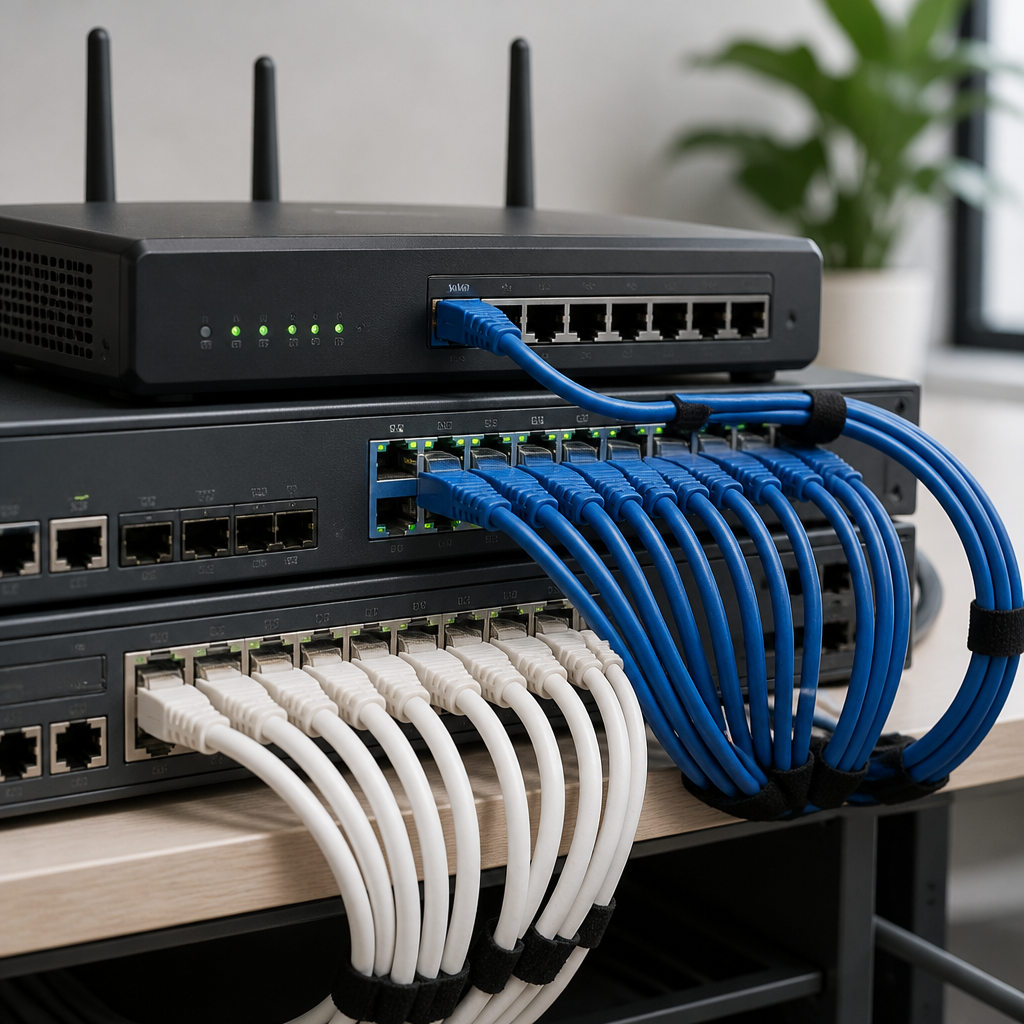
What Managed Network Services Actually Cover
Managed network services is a broad category. Understanding what a well-specified contract should include helps SME owners avoid paying for coverage that leaves material gaps.
Continuous Monitoring and Alerting
A credible managed service includes 24/7 monitoring of network devices, servers, and connectivity. Alerts are generated automatically when metrics exceed defined thresholds – unusual traffic volumes, hardware failure indicators, bandwidth saturation, or latency spikes. The critical point is that these alerts reach engineers who act on them, not a dashboard that no one checks out of hours.
In practice, proactive monitoring catches the majority of network issues before users are affected. A failing switch port, a router nearing memory limits, or a VPN gateway experiencing certificate errors can each be resolved without service disruption if identified early enough.
Patch Management and Firmware Updates
Unpatched network devices represent one of the most consistent attack vectors in SME environments. Routers, firewalls, and managed switches require regular firmware updates, and these updates often contain critical security fixes. A managed service provider applies these in controlled maintenance windows, ensuring coverage without disrupting business hours.
Cloud and Connectivity Management
For businesses using Microsoft 365, Azure, AWS, or Google Cloud Platform, the network is not confined to physical office infrastructure. VPN configurations, cloud firewall rules, SD-WAN policies, and hybrid identity settings all require ongoing management. An outsourced IT department that spans on-premise and cloud environments provides coverage across the full stack rather than managing each in isolation.
Pro tip: When evaluating a managed network services provider, ask specifically how they handle firmware updates on network devices and what their process is for emergency patching when a critical vulnerability is disclosed. A provider without a documented process is effectively leaving that decision to chance.
Security and Compliance: A Growing Obligation
Network security for London SMEs is no longer simply an IT concern. GDPR requires demonstrable technical and organisational measures to protect personal data. The National Cyber Security Centre (NCSC) Cyber Essentials scheme, recommended across government supply chains, includes specific controls at the network layer – boundary firewalls, secure configuration, and access control all depend on how the network is designed and managed.
A DIY approach struggles with compliance for a specific reason: demonstrability. Auditors and regulators require evidence of controls, not assertions. A managed service generates the logs, change records, and monitoring reports that constitute that evidence. A network managed informally by an internal generalist rarely produces documentation that satisfies a formal audit.

The NCSC’s guidance on securing networks for small organisations is publicly available and worth reviewing. It establishes the baseline that any competent network support provider should already be meeting. Where a provider cannot demonstrate compliance with that baseline, the engagement should be reconsidered.
Sector-specific obligations add further complexity. Financial services firms operating under FCA requirements, healthcare organisations handling patient data, and businesses within regulated supply chains each face network-level obligations that go beyond general data protection law. A network consultant in London with experience across these sectors brings regulatory familiarity that generalist IT support cannot replicate.
Pro tip: Request a written statement from any prospective managed IT provider confirming which Cyber Essentials controls are covered under their service. If they cannot produce one promptly, that itself is diagnostic.
Managed vs DIY vs Break-Fix: A Practical Comparison
The three models most SMEs operate under each have distinct cost structures, risk profiles, and operational outcomes. The table below sets out the key differences for a London business with 20 to 100 employees.
| Characteristic | DIY / Internal Generalist | Break-Fix (Ad-Hoc Contractor) | Managed Network Services |
|---|---|---|---|
| Cost structure | Fixed salary overhead with hidden time cost | Variable, unpredictable – charged on incident | Fixed monthly fee, inclusive of defined scope |
| Response to failure | Reactive, dependent on staff availability | Reactive, subject to contractor availability | Proactive monitoring plus defined SLA response |
| Security coverage | Inconsistent, rarely documented | Point-in-time fixes only, no ongoing posture | Continuous, with audit trails and patch management |
| Compliance documentation | Typically absent or informal | Not provided as standard | Produced as part of service delivery |
| Scalability | Limited by staff bandwidth | Limited by contractor availability | Scales with business under revised scope |
| Strategic input | Rare – operational focus only | None | Quarterly technology reviews and roadmap planning |
The break-fix model is particularly costly for businesses that have not quantified it. Each incident generates a separate invoice, typically at rates that reflect the urgency of the engagement. Over a 12-month period, the cumulative spend frequently exceeds the cost of a managed contract – without any of the preventive benefit.
Choosing a Network Consultant in London
The UK’s DSIT-commissioned research published in 2025 identified 12,867 active managed service providers in the UK, generating an estimated £51 billion in revenue. That level of supply means SME buyers have genuine choice – and also genuine risk of selecting a provider whose capabilities do not match the engagement.
Several criteria consistently differentiate effective providers from those that underdeliver.
Engineer Seniority and Direct Access
A common structural weakness in IT support is the tiered helpdesk model, where first contact is handled by analysts with limited technical authority. Resolution requires escalation, which introduces delay. For network issues – where a misconfiguration can affect an entire office instantly – direct access to senior engineers reduces mean time to resolution materially. Any provider who cannot describe the seniority of engineers handling network issues warrants further scrutiny.
Transparent Service Level Agreements
A well-specified SLA defines response times, resolution targets, and escalation paths for different categories of incident. It also defines what is and is not included in scope. Vague commitments around “best efforts” or “priority support” are not measurable and should not be accepted. An SLA for business network support in a 50-person London office should specify, at minimum, the response time for a complete network outage and the escalation path if that target is missed.
Local Presence and On-Site Capability
Remote support resolves the majority of network issues efficiently. However, hardware failures, physical cabling faults, and complex installations require on-site attendance. A network consultant in London with genuine local presence can attend within a defined window. Providers operating from outside the region frequently struggle to meet on-site commitments without advance notice.
Office Network Installation: Getting It Right from Day One
Office network installation is the point at which long-term performance is determined. London offices face specific challenges: older commercial buildings with constrained cable routes, high-density Wi-Fi environments where interference requires careful channel planning, and leased lines whose availability varies by postcode. A network designed for current headcount without headroom for growth requires expensive remediation within two to three years.
A properly specified installation includes structured cabling to a recognised standard, a correctly sized and configured switching layer, enterprise-grade wireless access points placed for coverage and capacity rather than convenience, and a firewall configured with meaningful rules rather than factory defaults. Documentation – network diagrams, IP address schemes, device inventories – should be produced at installation and updated on every change.
Organisations that have inherited poorly documented networks understand the operational cost of that deficit. When an issue occurs, diagnosis time is extended significantly because no one has a reliable record of how the network is configured. That time has a direct cost in staff hours and in the duration of any associated downtime.
iTO.London approaches office network installation as the foundation of an ongoing managed relationship. The design stage incorporates the client’s growth projections, cloud service dependencies, and any compliance requirements, producing an installation that supports operational objectives rather than simply connecting devices. For businesses considering a move or refurbishment, early engagement with a managed IT provider avoids the remedial work that follows a network built without that input.
For further reading on iTO.London’s approach to managed IT support for London businesses and cloud services management, the service pages provide additional detail on scope and delivery.
Frequently Asked Questions
What does network support for London businesses typically include?
Network support for London businesses generally covers monitoring and management of routers, firewalls, switches, and wireless infrastructure, alongside connectivity management, patch and firmware updates, incident response, and documentation. Comprehensive managed services also extend to cloud network components, VPN management, and security configuration aligned with frameworks such as Cyber Essentials.
How much does managed network support cost for a London SME?
Pricing varies based on the number of users, sites, and devices under management, and the scope of services included. Fixed monthly pricing is standard among reputable providers, which allows accurate budgeting. The relevant comparison is not against a zero-cost DIY baseline – it is against the combined cost of staff time, incident resolution, and the financial exposure of unmanaged risk.
What is the difference between a managed service provider and a break-fix IT contractor?
A break-fix contractor responds to incidents after they occur and charges per engagement. A managed service provider monitors systems continuously, addresses issues proactively, and operates under a recurring contract with defined SLAs. The managed model reduces both the frequency and the business impact of network incidents over time.
How long does an office network installation take in London?
A standard installation for a single-floor office of 20 to 50 users typically takes one to three days for physical infrastructure, followed by configuration and testing. More complex environments – multiple floors, high-density wireless requirements, or integration with existing cloud services – require longer. The design and planning phase preceding installation is equally important and should not be compressed to meet a move-in deadline.
Does managed network support cover Microsoft 365 and cloud services?
A full-service managed IT provider covers both on-premise network infrastructure and cloud environments. For businesses using Microsoft 365, Azure, AWS, or Google Cloud Platform, network-level configuration – firewall rules, VPN gateways, conditional access policies – intersects directly with cloud service delivery. Managing these in isolation from each other introduces gaps that neither a pure network provider nor a pure cloud provider will address.
What should an SLA for network support in London specify?
An SLA should define, at minimum: response time targets for different severity levels of incident (with a complete outage classified as the highest severity), escalation paths and timescales, the hours during which support is available, any exclusions from scope, and the mechanism for reporting and measuring SLA performance. SLAs that use terms like “priority” or “best efforts” without defined timescales are not measurable and offer limited contractual protection.
If your business is currently weighing its options for network support in London, we welcome your questions or observations in the comments below – practical experience from other SME owners often surfaces considerations that formal guidance does not cover.
We would love your feedback and any insights you would share with others. What perspective would you add?